Practical Drone Buying Advice And Top Commercial Flight Services Guide
Introduction
Finding a great flying gadget often overwhelms modern shoppers. Retailers display countless models with vastly different parts. Kids fly lightweight toys across neighborhood parks. Meanwhile, giant sprayers nourish expansive wheat fields. Your specific assignment must guide your equipment choices. Smart buyers study detailed drone reviews before purchasing. Next, compare drone specifications to spot real flight ceilings. Running a direct drone comparison reveals huge price differences. Yet buying hardware makes little sense for temporary projects. Instead, business owners book verified drone services to save money. The helpful directory on DronesBee simplifies gear analysis. It also connects clients with licensed operators across many regions.
Start With Your Main Drone Goal
Begin every project by naming your primary mission. Some creators film quick vacation clips for family memories. Others record fast sporting matches from above. Real estate agents photograph newly built houses. Road crews map property lines with precise sensors. Farmers track dry patches across corn rows.
No single craft excels at every task. Tiny flyers fail in strong winds. Large industrial rigs cost far too much for weekend fun. Therefore, clarify your exact goal before spending any funds.
What to Check in Drone Reviews
Honest reports reveal real hardware limits before you pay. Begin by examining camera sensor quality. Good lenses produce sharp photos during windy days. Next, note actual battery runtimes. Most retail packs last under thirty minutes.
Always check the total aircraft weight. Heavy units trigger registration rules with civil aviation offices. You also need strong radio links and collision sensors. Safe flight software prevents hard tree impacts. Finally, confirm that dealers stock replacement props. Cheap models become useless junk once tiny plastic clips snap.
Make a Simple Drone Comparison
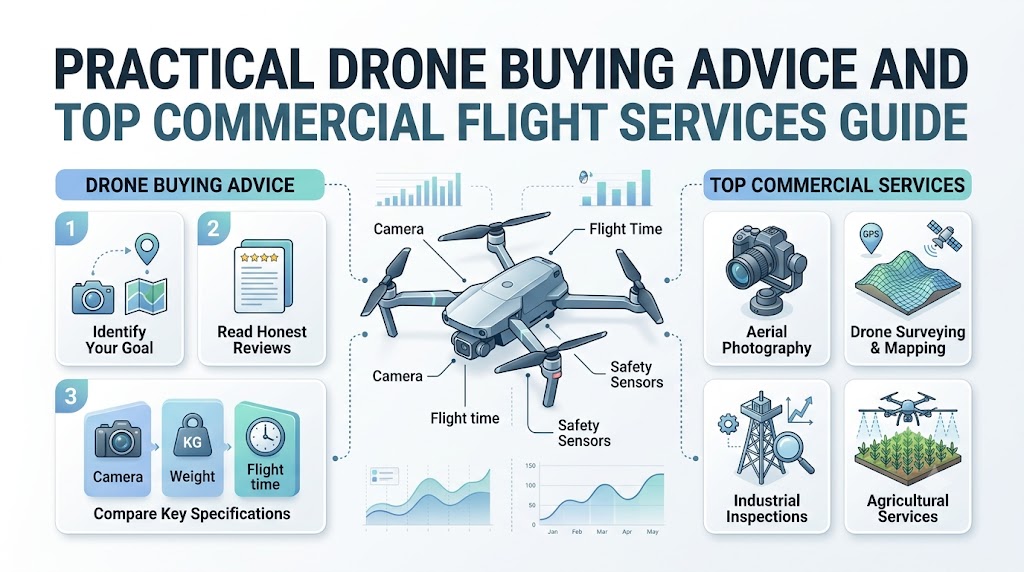
Wise shoppers inspect several models before opening their wallets. Compare hard technical facts instead of trusting flashy promotional videos. A higher price tag never guarantees superior field performance. You can evaluate the most vital aircraft factors using this simple checklist:
- Camera optics: Check photo resolution and video clarity because sharp lenses deliver crisp images for commercial clients.
- Flight time: Count total airborne minutes because longer flights save valuable charging time between runs.
- Aircraft weight: Weigh total grams on a scale because lighter models avoid complex government registration steps.
- Control range: Verify maximum signal distance because strong connections stop unexpected control cutouts during flights.
- Safety features: Look for crash detection sensors because automatic braking prevents expensive collisions with trees.
- Support and parts: Confirm spare propeller availability because easy repairs keep your aircraft working after minor bumps.
- Package price: Add up the full setup cost because counting extras protects your wallet from hidden accessory fees.
Factor in extra equipment costs like spare batteries and storage cases. These extra supplies quickly raise the total bill.
Finding the Best Drones for Your Job
Selecting the best drones requires matching features to your daily routine. Rookies benefit from durable frames with prop guards. These light models survive clumsy basement landings. Backpackers want folding arms that slip into small bags.
Film crews buy large sensors for cinematic sunset clips. Surveyors pick precise satellite receivers for boundary maps. Crop dusters order heavy tanks that hold chemical sprays. Purchase only the features that advance your actual work.
When You Need Drone Services
Owning expensive aircraft rarely makes financial sense for occasional assignments. High-end camera craft run into thousands of dollars. Pilots also spend months practicing delicate flight maneuvers.
Commercial tasks demand active liability insurance and commercial flight permits. Renewing these certifications takes time and cash. Booking an outside specialist eliminates gear maintenance hassles. An experienced pilot brings top equipment and absorbs all operational risks.
How to Find Drone Pilots Near Me
Clients frequently search for drone pilots near me to handle complex imaging tasks. However, you must vet prospective operators thoroughly. Review these core hiring points before booking any local pilot:
- Official license: Ask if the pilot holds an active commercial card that proves legal aviation training.
- Insurance policy: Confirm third-party liability coverage so your business stays safe from accidental property damage.
- Past work history: Ask for previous project samples to verify sharp photos and clean digital maps.
- Safety planning: Review their hazard checklist to ensure the crew monitors weather shifts and flight hazards.
Ensure your hire has tackled similar projects before. Local specialists also respect regional airspace ceilings near busy regional hubs.
Aerial Photography Services
Commercial aerial photography services help businesses win new clients. Realtors display sprawling estates to attract wealthy buyers. Luxury resorts display pristine pools and tennis courts. Film producers record high-speed chases from dynamic sky angles.
Stunning aerial media requires more than an expensive lens. An operator must track changing sunlight and hold stable flight paths. Masterful fliers create buttery-smooth video sequences that enchant viewers.
Drone Surveying Services
Land measuring once demanded weeks of tedious brush clearing. Modern drone surveying services scan expansive job sites within hours. The flyer collects hundreds of overlapping photos from high elevations. Advanced software blends these images into precise digital surface models.
Civil engineers spot steep elevation drops across future highways. Excavators calculate gravel volumes to monitor earthmoving progress. Nevertheless, accurate survey outputs demand correct flight speeds and calibrated optics. Careless mission planning ruins the entire spatial dataset.
Drone Inspection Services
Scaling tall utility poles places technicians in grave danger. Specialized drone inspection services safeguard workers by keeping boots on the turf. Compact aircraft inspect church steeples, wind turbines, and metal towers. They quickly scan high-voltage lines, highway bridges, and solar arrays.
Sensors identify cracked masonry, loose bolts, and corrosion patches. However, camera lenses cannot torque loose bolts or test structural steel hardness. Unmanned flyers detect hidden flaws early, but ground crews still perform the physical repairs.
Agricultural Drone Services
Modern farms span vast stretches of countryside. Specialized agricultural drone services provide growers with vital crop intelligence. Multispectral sensors detect plant stress long before leaves display brown spots. These aerial diagnostics tell farmhands where to irrigate dry soil.
Larger platforms disperse liquid fertilizer directly over weed patches. Targeted spraying cuts input costs and prevents chemical runoff into local waterways. These industrial crop dusters rely on massive battery packs and automated flight paths.
Real-Life Scenarios
- A rancher discovers stray cattle: A rancher searched dense brush for three lost calves. He hired an aerial operator with a thermal camera. The pilot spotted the calves near a creek within thirty minutes, saving the rancher hours of riding.
- A church repairs storm damage: High winds tore tiles from a historic cathedral steeple. The council avoided renting expensive metal scaffolding. A technician flew a compact camera flyer, capturing crisp photos of the loose slate within ten minutes.
- A contractor verifies dirt volumes: A builder needed to measure a massive sand pile before pouring foundations. An imaging specialist flew an automated grid pattern over the site. Specialized software calculated the exact volume, keeping the foundation project on schedule.
Common Mistakes to Avoid
- Ignoring airspace rules: Amateurs launch near busy airfields without clearance. Always review national aviation maps before starting your motors.
- Depleting power packs: Freezing temperatures slash lithium battery runtimes dramatically. Warm your spare packs inside a thermal bag before takeoff.
- Battling high winds: Strong gusts quickly push lightweight machines into tree branches. Monitor wind apps and cancel flights during gusty weather.
- Foregoing insurance: Operating near houses without liability protection creates severe legal risks. Always verify that your operator carries active commercial insurance.
- Underestimating hidden costs: Flight kits rarely include sunshades, charging hubs, or rugged cases. Set aside extra cash for mandatory field accessories.
- Purchasing complex gear: Beginners buy expensive professional rigs and crash on day one. Master simple flight controls on a cheap trainer first.
- Trusting radar sensors: Safety sensors frequently miss thin power lines and leafless twigs. Maintain constant visual contact with your aircraft throughout every run.
- Operating in wet weather: Moisture enters motor housings and shorts delicate electronic speed controllers. Land your aircraft immediately whenever dark rain clouds form overhead.
How DronesBee Can Help
Sorting through technical flying gear demands hours of research. The central hub at DronesBee gathers verified drone reviews in a single spot. Shoppers can execute a swift drone comparison across major brands. The database also shares clear drone specifications regarding payload capacity and flight times.
When purchasing hardware seems impractical, the site simplifies outsourcing. It connects project managers with certified operators for construction, media, and farming tasks. Hobbyists also discover educational flight resources to build skills and fly legally.
1. Do novices need extensive simulator training before flying outside?
Beginners master basic stick controls faster by practicing inside simulator software. Virtual practice teaches muscle memory without risking broken propellers. Once you control pitch and yaw smoothly, move outside to a wide field. Keep your aircraft close while learning basic maneuvers.
2. Which factors decrease lithium flight batteries the fastest?
High winds, freezing temperatures, and aggressive throttle punch drain batteries rapidly. Heavy clip-on accessories also force motors to spin faster, guzzling valuable watts. To maximize airtime, fly smoothly and avoid fighting stiff headwinds. Always land before battery levels drop below twenty percent.
3. Does commercial sky work require special pilot certification?
Commercial operations demand an official remote pilot certificate from your national aviation agency. Applicants must pass a written aeronautical knowledge exam covering weather, airspace, and emergency procedures. Fun recreational flights require only simple registration. Never accept payment for flights without holding an active commercial license.
4. What distinct advantages do professional flight crews offer over hobbyists?
Professional crews provide commercial liability policies, certified pilots, and high-tier sensors. They understand complex airspace authorizations near municipal airports. Pros also utilize dedicated post-processing software to convert raw imagery into actionable business data. Their skill saves clients from costly site accidents and incomplete datasets.
5. Can moisture damage an unmanned aircraft during humid mornings?
Heavy fog and morning dew can short unsealed electrical connections inside motor wells. Water droplets on lenses also ruin photo clarity with blurred distortions. Unless a machine features an official water-resistance rating, pack up your gear until morning moisture evaporates completely.
6. Why do surveyors prefer mechanical global shutters over electronic rolling shutters?
Rolling shutters record images line by line, causing bending distortions when aircraft travel at speed. Mechanical global shutters expose the entire sensor instantly, preserving straight geometry. This sharp precision ensures that land mapping software aligns points correctly. Precision-minded surveyors always choose global shutter sensors.
7. What role does maximum takeoff weight play in aircraft selection?
Maximum takeoff weight specifies the absolute heaviest load an aircraft can safely carry aloft. Exceeding this limit strains brushless motors, drains batteries rapidly, and risks mid-air motor shutdowns. Always calculate the weight of added cameras, mounts, and batteries before launching your mission.
8. Which flying altitudes remain safe and legal for consumer craft?
Civil aviation authorities cap unmanned flights at four hundred feet above ground level. This safety cushion keeps small drones far below low-flying passenger airplanes and helicopters. Maintain constant visual line of sight with your craft. Never fly above clouds or out of view.
9. Can multispectral cameras assess plant health beneath the soil?
Multispectral sensors evaluate light reflection from foliage rather than looking underground. Healthy leaves reflect green light and near-infrared energy, while struggling plants absorb more radiation. These indices help agronomists pinpoint dehydration early, but the sensors cannot directly analyze buried roots or subsurface pests.
10. Which hardware traits justify the high prices of industrial airframes?
Enterprise airframes incorporate redundant battery systems, RTK positioning modules, and weather-sealed housings. Their advanced transmitters maintain crisp video feeds through dense industrial interference. These machines also carry swappable thermal, zoom, and mapping sensors. Companies gladly pay top dollar for field durability and pinpoint positioning.
11. What automatic safety protocol initiates when control signals fail?
Reliable aircraft execute an automated failsafe procedure whenever radio contact drops. The system ascends to a preset altitude, follows GPS coordinates, and touches down at the original launch pad. Operators should adjust this return ceiling high enough to clear surrounding power lines and trees.
12. How do agronomists determine optimal aerial dispersal rates for liquid fertilizer?
Farming teams evaluate crop height, pest pressure, and target acreage before filling spray tanks. Large rotary nozzles break liquid into fine droplets that coat leaves evenly without excess runoff. Operators also monitor ambient wind speeds to prevent delicate chemical mist from blowing onto neighboring plots.
Conclusion
Picking suitable flight gear begins by identifying your primary operational needs. Compare vital specifications, inspect honest field reviews, and calculate full ownership expenses before buying. When advanced tasks demand specialized sensors or certified fliers, hire verified local talent. Choose the drone for the job, not just the drone with the biggest feature list.