Evaluating DevSecOps Certified Professional (DSOCP) Methodologies In Continuous Delivery And Deployment Environments
Introduction
Modern technology enterprises demand rapid software releases alongside uncompromising system defenses. The DevSecOps Certified Professional (DSOCP) establishes verifiable technical benchmarks for engineers who embed programmatic security controls across automated deployment pipelines. System administrators, platform architects, application developers, and security analysts gain an actionable operational roadmap through this comprehensive evaluation.
Cloud-native ecosystems amplify systemic risks whenever engineering teams prioritize release speed over defensive governance. Manual security checks at the conclusion of development cycles trigger expensive architectural revisions, stall production deployments, and leave critical attack vectors wide open. Shifting security verifications left transforms risk management into an automated, shared operational routine across software delivery squads.
Discerning valuable engineering credentials from superficial badges presents a substantial challenge in today's crowded market. This detailed review cuts through industry hyperbole to inspect real project outcomes, technical prerequisites, and professional trajectories. Engineers seeking to master defensive infrastructure automation gain reliable clarity to propel their technical careers forward.
What is the DevSecOps Certified Professional (DSOCP)?
The DevSecOps Certified Professional (DSOCP) validates an engineer's capability to build, orchestrate, and maintain resilient deployment infrastructure. Rather than emphasizing passive memorization of abstract compliance documentation, this technical standard tests hands-on proficiency in production environments. It directly eliminates the longstanding operational rift separating product delivery speed from defensive platform resilience.
Dynamic microservices, distributed cloud meshes, and container orchestration engines define modern computing infrastructure. Static security documentation completely fails to prevent misconfigurations or zero-day intrusions across these complex architectures. The curriculum instead mandates hands-on policy testing, continuous automated pipeline scanning, distributed secret management, and real-time kernel observability.
By focusing on battle-tested toolchains, this credential equips engineers to eliminate deployment blockers permanently. Candidates master the craft of building invisible, programmatic guardrails that accelerate feature delivery while guaranteeing policy compliance. The program aligns directly with elite architectural standards observed across premier global technology operations.
Who Should Pursue DevSecOps Certified Professional (DSOCP)?
Practitioners across the modern delivery spectrum extract substantial career capital from this curriculum. Application developers discover how to write defensive code and analyze third-party library risks before pushing commits. Infrastructure operators, site reliability engineers, and platform builders master the programmatic enforcement of configuration baselines long before deploying cloud resources.
Traditional penetration testers and manual security auditors must acquire these automation techniques to remain viable within agile environments. Converting static security checklists into dynamic continuous integration rules demands genuine technical fluency with contemporary release systems. Engineering managers, principal architects, and technical team leads simultaneously use these frameworks to set uncompromising governance baselines without degrading developer productivity.
The credential offers exceptional career utility across international enterprise hubs and expanding technology ecosystems throughout India. Financial networks, healthcare providers, cloud service firms, and enterprise software organizations actively recruit engineers who can protect mission-critical environments.
Why DevSecOps Certified Professional (DSOCP) is Valuable
The market consistently rewards cross-functional talent capable of blending pipeline automation with rigorous defense mechanisms. Fast pipelines without security scanning merely deploy dangerous platform vulnerabilities into customer-facing runtimes at unprecedented speed. Technology organizations understand that isolated security departments inevitably create severe communication gaps and cause costly security incident cleanups.
Individual utilities come and go, but core architectural patterns endure. The DevSecOps Certified Professional (DSOCP) emphasizes foundational security principles, defensive architecture design, and programmatic validation routines that withstand shifting industry tooling trends. Engineers learn to assess architectural trade-offs, construct automated feedback mechanisms, and deliver durable deployment platforms.
Earning this credential builds lasting professional authority and opens access to strategic technical roles. Global regulatory regimes, supply chain security mandates, and constant infrastructure intrusion attempts compel businesses to hire dependable security builders. Holding this certification signals to prospective employers that an engineer builds high-velocity platforms without creating security compromises.
DevSecOps Certified Professional (DSOCP) Certification Overview
DevOpsSchool delivers the training tracks and assessment environments for this credential. The educational framework employs an engineering-focused curriculum that emphasizes active technical design over multiple-choice guesswork. Instructors guide participants through realistic system failures, multi-stage pipeline construction, and hardened infrastructure deployments.
Candidates prove their operational readiness by writing functional pipeline code, configuring automated scanners, and resolving simulated infrastructure compromises under strict time limits. Industry practitioners manage the program content, continuously refreshing technical modules to mirror active software vulnerabilities, updated cloud frameworks, and emerging pipeline patterns.
The certification cleanly organizes core defensive concepts across critical operational domains, encompassing static analysis, dynamic testing, dependency auditing, and cloud configuration monitoring. Through well-defined project checkpoints, the program delivers unambiguous proof of an engineer's readiness to secure complex modern platforms.
DevSecOps Certified Professional (DSOCP) Certification Tracks & Levels
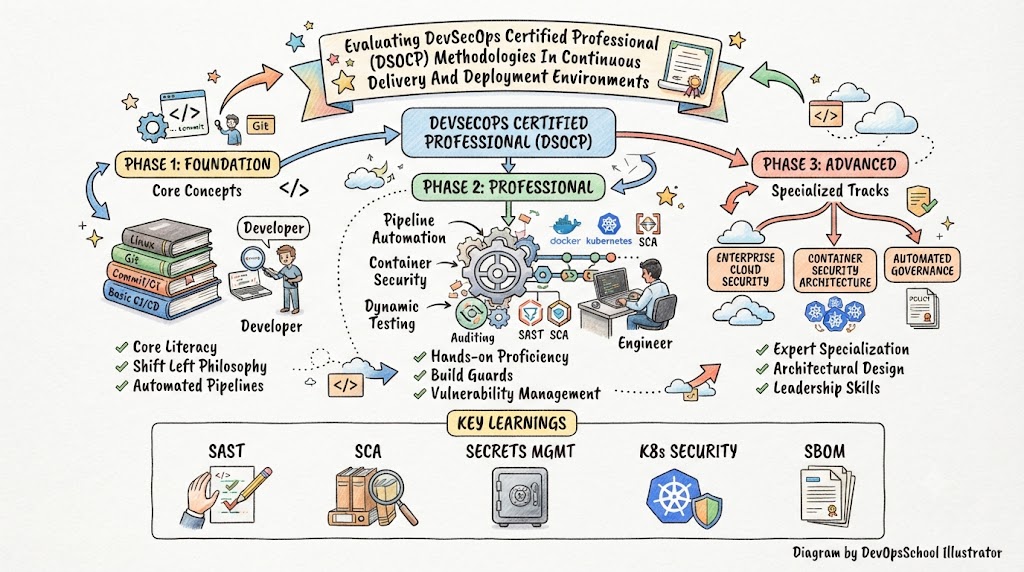
The program organizes technical competencies into progressive tiers that mirror real-world engineering responsibilities. The entry track instills baseline defensive mindsets, foundational syntax rules, and automated integration hooks for code repositories. This level provides the groundwork required to operate effectively inside enterprise delivery pipelines.
The professional level immerses engineers in advanced toolchain orchestration, policy enforcement engines, and container runtime isolation. Practitioners at this tier configure security checks that provide immediate feedback without frustrating application developers. Participants interact directly with infrastructure scanners, secret rotation servers, and software inventory generators.
The advanced level targets lead architects, principal consultants, and security managers who design enterprise defense topologies. This tier covers runtime threat defense, zero-trust network topologies, and automated incident triage systems. These integrated tiers establish a transparent ladder connecting day-to-day scripting with enterprise platform governance.
Complete DevSecOps Certified Professional (DSOCP) Certification Breakdown
Instead of traditional tabular layouts, the complete certification roadmap is organized below into distinct professional tiers:
- Foundation Security:
- Level: Entry to Intermediate.
- Who it is for: Junior Developers, QA Testers, and Junior Admins.
- Prerequisites: Basic Linux commands, Git commands, and basic CI/CD ideas.
- Skills Covered: Static code reviews, secret detection, and repository hygiene.
- Recommended Order: First step.
- DevSecOps Professional:
- Level: Intermediate to Advanced.
- Who it is for: DevOps Specialists, Cloud Admins, and Security Analysts.
- Prerequisites: Two years of automation work and scripting fluency.
- Skills Covered: SAST, DAST, SCA, container hardening, and policy-as-code.
- Recommended Order: Second step.
- Cloud Security Platform:
- Level: Intermediate to Advanced.
- Who it is for: Platform Architects, Cloud Engineers, and System Administrators.
- Prerequisites: Cloud fundamentals and Terraform experience.
- Skills Covered: CSPM auditing, IAM boundaries, and IaC scanning.
- Recommended Order: Third step.
- Runtime & Container Defense:
- Level: Advanced.
- Who it is for: SRE Specialists, Kubernetes Admins, and SecOps personnel.
- Prerequisites: Docker, Kubernetes administration, and Linux internals.
- Skills Covered: Admission controllers, runtime auditing, and service meshes.
- Recommended Order: Fourth step.
- Security Governance & Architecture:
- Level: Expert / Leadership.
- Who it is for: Principal Engineers, Security Architects, and Technical Leads.
- Prerequisites: Extensive delivery and architecture experience.
- Skills Covered: Threat modeling, SBOM validation, and compliance automation.
- Recommended Order: Fifth step.
Detailed Guide for Each DevSecOps Certified Professional (DSOCP) Certification
DevSecOps Certified Professional (DSOCP) – Foundation Security
What it is
This credential validates an engineer's ability to uncover baseline security flaws within application code and build automation scripts. It confirms that the professional understands automated pipeline testing mechanics and safe code management practices.
Who should take it
Junior software developers, quality assurance testers, and entry-level operations technicians who want a structured path into pipeline defense. Professionals with under two years of commercial experience gain immediate technical traction here.
Skills you’ll gain
- Flag common code vulnerabilities using industry-standard risk indices
- Embed secret scanning tools inside local and remote Git workflows
- Run static application security tests during continuous integration stages
- Write custom pre-commit hooks to block exposed access keys
- Audit open-source software libraries for known vulnerabilities
Real-world projects you should be able to do
- Write Git hooks that intercept and terminate commits containing access tokens
- Build a continuous integration workflow that executes automated code linting on every pull request
- Create an automated alert system that flags vulnerable project dependencies
Preparation plan
- 7–14 days plan: Master Git security operations, repository scanners, and common application security vulnerabilities.
- 30 days plan: Construct local automated pipelines, execute static scanners against open-source repositories, and complete basic exercises.
- 60 days plan: Analyze dependency vulnerability trees, build end-to-end continuous integration workflows, and evaluate scanner diagnostics.
Common mistakes
- Trusting manual code reviews while ignoring automated pipeline scanners
- Confusing harmless scanner notices with urgent security vulnerabilities
- Treating security as an isolated post-build chore instead of integrating it into regular Git routines
Best next certification after this
- Same-track option: DevSecOps Certified Professional (DSOCP) – Core Professional Level
- Cross-track option: Certified Kubernetes Administrator (CKA)
- Leadership option: Certified Agile Technical Team Lead
DevSecOps Certified Professional (DSOCP) – Core Professional Level
What it is
This benchmark credential validates an engineer's capability to deploy complete, automated security pipelines across containerized platforms and multi-cloud footprints. It represents the industry standard for hands-on, production-ready security engineering.
Who should take it
DevOps practitioners, cloud engineers, and technical analysts possessing two to five years of hands-on platform experience. The curriculum targets professionals who actively manage build infrastructures and deployment pipelines.
Skills you’ll gain
- Integrate SAST, DAST, and dependency analysis tools into enterprise deployment systems
- Inspect, minimize, and harden base container images for production use
- Audit infrastructure as code definitions to prevent configuration drift
- Inject short-lived authentication credentials into running jobs using dynamic secret managers
- Establish strict pipeline break rules based on vulnerability score cutoffs
Real-world projects you should be able to do
- Construct a complete deployment pipeline that enforces automated security gates across multiple scanning stages
- Deploy HashiCorp Vault to supply transient access keys to automated runners
- Build an automated container pipeline that outputs stripped-down, rootless runtime images
Preparation plan
- 7–14 days plan: Drill container analysis utilities, pipeline scripting syntax, and policy-as-code definitions in sandbox labs.
- 30 days plan: Build sample deployment pipelines combining three distinct automated security scanning utilities.
- 60 days plan: Construct complete staging pipelines, run false-positive analysis drills, and write automated gatekeeping policies.
Common mistakes
- Enabling security scanners without establishing explicit failure thresholds
- Hardcoding static credentials into pipeline environment variables
- Flooding development teams with raw scan reports instead of filtered, high-priority issues
Best next certification after this
- Same-track option: DevSecOps Certified Professional (DSOCP) – Runtime & Container Defense
- Cross-track option: Certified Site Reliability Engineer (CSRE)
- Leadership option: DevSecOps Engineering Manager Certification
DevSecOps Certified Professional (DSOCP) – Cloud Security Platform
What it is
This certification confirms an engineer's ability to enforce security policies programmatically across cloud infrastructure and provisioning templates. It demonstrates the technical skills required to govern multi-cloud resources before and after activation.
Who should take it
Cloud operators, infrastructure architects, and platform team members who manage infrastructure on AWS, Azure, or Google Cloud. Candidates need practical experience writing declarative provisioning files with tools like Terraform.
Skills you’ll gain
- Validate Terraform and CloudFormation scripts against security baselines
- Write policy-as-code rules that stop insecure cloud resource provisioning
- Build least-privilege identity and access management policies
- Interpret automated cloud security posture management assessments
- Build automated logging, compliance monitoring, and anomaly detection workflows
Real-world projects you should be able to do
- Write Open Policy Agent rules that reject publicly accessible storage buckets and unencrypted disks
- Deploy an automated infrastructure pipeline that evaluates Terraform plans against compliance rules
- Centralize cloud audit trails and access event streaming across multiple production accounts
Preparation plan
- 7–14 days plan: Focus on infrastructure code linters, cloud access models, and policy syntax mechanics.
- 30 days plan: Author compliance policies for common cloud designs and embed them into automated pull request checks.
- 60 days plan: Engineer a complete cloud compliance platform covering identity limits, network isolation, and automated remediation.
Common mistakes
- Relying on provider console warnings instead of running pre-provisioning checks
- Granting broad administrative permissions to resolve pipeline access errors quickly
- Failing to test policy rules against unconventional infrastructure designs
Best next certification after this
- Same-track option: DevSecOps Certified Professional (DSOCP) – Security Governance & Architecture
- Cross-track option: Cloud FinOps Certified Practitioner
- Leadership option: Cloud Platform Director Certification
DevSecOps Certified Professional (DSOCP) – Runtime & Container Defense
What it is
This credential validates an engineer's ability to protect live container runtimes, service mesh architectures, and Kubernetes clusters. It proves an operator can defend running production workloads against active intrusion attempts.
Who should take it
Site reliability engineers, Kubernetes cluster administrators, and security operations personnel defending production environments. Candidates need direct experience managing containerized systems.
Skills you’ll gain
- Harden Kubernetes cluster nodes and control planes against industry benchmarks
- Deploy dynamic admission controllers to block non-compliant workloads
- Configure runtime intrusion detection systems to intercept anomalous kernel events
- Enforce container network micro-segmentation and strict mutual TLS communication
- Sign container images cryptographically and verify their provenance at deploy time
Real-world projects you should be able to do
- Install and tune Falco to trigger alerts whenever unexpected binaries execute inside production pods
- Write Kyverno or Gatekeeper admission rules that enforce non-root user execution
- Configure a service mesh to mandate mutual TLS and granular routing between microservices
Preparation plan
- 7–14 days plan: Study Kubernetes security contexts, admission webhooks, and Linux monitoring primitives.
- 30 days plan: Deploy runtime monitoring tools into test clusters, simulate privilege escalations, and tune detection rules.
- 60 days plan: Build an end-to-end hardened Kubernetes runtime featuring admission gates, signed image enforcement, and micro-segmentation.
Common mistakes
- Assuming build-time container scanning eliminates the need for runtime monitoring
- Allowing applications to run with full root privileges inside containers
- Applying overly restrictive network policies that disrupt microservice dependencies and cause production outages
Best next certification after this
- Same-track option: DevSecOps Certified Professional (DSOCP) – Security Governance & Architecture
- Cross-track option: Certified Reliability Engineer / Advanced SRE
- Leadership option: Enterprise Infrastructure Security Officer
DevSecOps Certified Professional (DSOCP) – Security Governance & Architecture
What it is
This credential confirms an architect's capacity to design enterprise-wide platform security systems, defend the software supply chain, and automate compliance auditing. It marks the pinnacle of technical platform governance.
Who should take it
Principal engineers, security architects, technical directors, and enterprise leads guiding organizational roadmaps. Candidates need at least seven years of engineering and architectural design experience.
Skills you’ll gain
- Execute threat modeling against distributed cloud systems
- Generate, cryptographically sign, and verify Software Bills of Materials
- Establish enterprise vulnerability triage workflows and remediation deadlines
- Map complex regulatory standards into automated pipeline gates
- Architect enterprise-wide secret rotation and encryption key infrastructures
Real-world projects you should be able to do
- Design a software supply chain security system that verifies artifact provenance across the entire delivery path
- Execute threat modeling for a high-volume financial transactions platform and produce technical mitigation steps
- Build an automated compliance reporting framework that pulls evidence directly from infrastructure state files
Preparation plan
- 7–14 days plan: Master threat modeling frameworks, supply chain vulnerability vectors, and compliance standards.
- 30 days plan: Build automated software bill of materials ingestion and validation engines for multi-tier applications.
- 60 days plan: Create comprehensive security blueprints that unify automated enforcement, artifact verification, and executive auditing.
Common mistakes
- Generating high-level architectural paperwork while ignoring low-level technical execution details
- Mandating strict security rules without providing developers with functional self-service tools
- Forgetting to design fallback operational procedures for pipeline scanner outages
Best next certification after this
- Same-track option: Specialized Enterprise Threat Hunter
- Cross-track option: Executive Enterprise Architect Certification
- Leadership option: Chief Information Security Officer (CISO) Executive Program
Choose Your Learning Path
DevOps Path
The DevOps path teaches engineers to embed automated security tools inside continuous integration and delivery pipelines without slowing down feature releases. Candidates discover how to configure code analyzers, container linters, and secret scanners to execute quickly during pull request evaluations. This pathway produces engineers who provide developers with actionable security feedback within minutes, turning security checks into friction-free engineering habits.
DevSecOps Path
The DevSecOps path offers a deep dive into offensive and defensive application security mechanics. Engineers following this curriculum master complex dynamic scanners, establish automated penetration testing environments, and enforce policy-as-code rules across distributed systems. This track builds domain specialists who can eliminate complex pipeline vulnerabilities, maintain uncompromising security guardrails, and lead technical security transformations across enterprise organizations.
SRE Path
The Site Reliability Engineering path concentrates on workload isolation, platform resilience, and runtime visibility during active infrastructure attacks. Engineers on this route correlate security log telemetry with operational health metrics, intercept irregular kernel calls, and enforce container admission rules. This track prepares professionals to protect data integrity and maintain continuous system uptime even while under active exploitation attempts.
AIOps Path
The AIOps path focuses on deploying machine learning algorithms to ingest, parse, and analyze massive volumes of system telemetry and security audit logs. Specialists master the art of building smart alert aggregation systems that discard routine background noise and surface genuine operational threats. This track enables engineers to architect self-healing infrastructure systems that detect and neutralize unauthorized access patterns automatically.
MLOps Path
The MLOps path directly tackles the distinct operational vulnerabilities found in machine learning pipelines, dataset ingestion systems, and automated model delivery. Engineers study methods to secure raw training data, prevent data poisoning attacks, track model artifact provenance, and protect proprietary model weights. This specialization proves indispensable for engineering teams operationalizing artificial intelligence workloads under stringent privacy and compliance mandates.
DataOps Path
The DataOps path brings continuous delivery controls and automated security testing to big data platforms and analytics workflows. Engineers following this discipline learn to mask sensitive data fields, enforce dynamic access privileges across data storage lakes, and validate schema integrity in transit. This route ensures that data engineering teams build reliable data products that satisfy both organizational analytics needs and international privacy regulations.
FinOps Path
The FinOps path merges infrastructure security governance with cloud cost management, recognizing that infrastructure misconfigurations often trigger catastrophic cloud billing spikes. Engineers learn to enforce automated resource termination policies and decommission orphaned assets, preventing malicious actors from hijacking resources for unauthorized computing. This specialization equips professionals to optimize enterprise cloud investments while shrinking the overall attack surface.
Role to Recommended DevSecOps Certified Professional (DSOCP) Certifications
The recommendations linking job functions to ideal credentials are structured below:
- DevOps Engineer: Primary recommendation is the DevSecOps Certified Professional (DSOCP) Core Professional Level, with a secondary focus on Foundation Security. Strategic value includes delivering frictionless pipeline automation with built-in security checks.
- SRE: Primary recommendation is the DevSecOps Certified Professional (DSOCP) Runtime & Container Defense, with a secondary focus on Cloud Security Platform. Strategic value includes defending live production clusters against operational outages and intrusions.
- Platform Engineer: Primary recommendation is the DevSecOps Certified Professional (DSOCP) Cloud Security Platform, with a secondary focus on Core Professional Level. Strategic value includes equipping developer teams with secure, self-service infrastructure blueprints.
- Cloud Engineer: Primary recommendation is the DevSecOps Certified Professional (DSOCP) Cloud Security Platform, with a secondary focus on Runtime & Container Defense. Strategic value includes validating cloud environments against strict security and governance baselines.
- Security Engineer: Primary recommendation is the DevSecOps Certified Professional (DSOCP) Core Professional Level, with a secondary focus on Security Governance & Architecture. Strategic value includes transforming static security reviews into dynamic, automated pipeline guardrails.
- Data Engineer: Primary recommendation is the DevSecOps Certified Professional (DSOCP) Foundation Security, with a secondary focus on Cloud Security Platform. Strategic value includes hardening distributed data pipelines, ETL routines, and storage infrastructure.
- FinOps Practitioner: Primary recommendation is the DevSecOps Certified Professional (DSOCP) Foundation Security, with a secondary focus on Cloud Security Platform. Strategic value includes spotting unmanaged resource growth and eliminating security-driven cost overruns.
- Engineering Manager: Primary recommendation is the DevSecOps Certified Professional (DSOCP) Security Governance & Architecture, with a secondary focus on Core Professional Level. Strategic value includes establishing organizational security governance without slowing down feature releases.
Next Certifications to Take After DevSecOps Certified Professional (DSOCP)
Same Track Progression
Earning this certification provides the launching pad for elite architectural specialization within pipeline and platform defense. Ambitious engineers should target advanced credentials focusing on kernel-level container auditing, sophisticated supply chain defense systems, and automated runtime response mechanisms. Mastering advanced admission webhooks, cryptographic artifact signing, and zero-trust service meshes cements your reputation as an elite platform security specialist.
Advancing within this domain also demands deep expertise in custom security tool development, automated vulnerability triage, and regulatory compliance mapping. This elite specialization ensures you can step into demanding enterprise situations where off-the-shelf software fails, giving you the skills to build bespoke automation systems for complex architectures.
Cross-Track Expansion
Elite technology leaders cultivate comprehensive expertise across adjacent operational fields to avoid narrow thinking. Professionals who hold this credential gain significant competitive advantages by tackling advanced Site Reliability Engineering coursework, mastering availability metrics, error budgets, and chaos engineering drills. Understanding how defensive controls impact system performance, transaction latency, and service availability makes you an indispensable enterprise asset.
Similarly, expanding into FinOps and modern platform engineering allows you to evaluate infrastructure investments through financial and operational efficiency lenses. Learning to provision infrastructure automatically while keeping resource costs within tight boundaries transforms you into a versatile, high-impact technical contributor capable of leading across company departments.
Leadership & Management Track
Engineers moving into leadership positions must shift their focus from technical configuration tasks to enterprise strategy and organizational management. Experienced practitioners should pursue enterprise architecture credentials, executive technical leadership diplomas, and information security management programs. These advanced courses cultivate critical competencies in executive communication, technical hiring, risk analysis, and resource planning.
Strategic education empowers technical leaders to articulate the financial costs of technical debt to executive boards convincingly. It bridges the gap between hands-on engineering practices and corporate compliance demands, enabling leaders to establish a culture of shared security ownership across large engineering organizations.
Training & Certification Support Providers for DevSecOps Certified Professional (DSOCP)
DevOpsSchool
DevOpsSchool provides comprehensive training programs across modern infrastructure automation, cloud management, and continuous delivery disciplines. The organization designs its curriculum specifically for working professionals, offering live instructor-led sessions, practical lab environments, and direct certification mentoring. Students build production-grade deployment pipelines, configure automated scanners, and resolve real-world infrastructure failures. By focusing on practical engineering execution rather than theoretical memorization, the platform helps technical professionals build skills that immediately enhance day-to-day enterprise productivity.
Cotocus
Cotocus delivers dedicated technical training and IT consulting services centered on enterprise automation, infrastructure modernization, and organizational transformation. Their instructors bring active industry consulting experience directly into the virtual classroom, guiding teams through complex container, cloud, and deployment challenges. The curriculum emphasizes real-world architectural design, continuous delivery integration, and resilient infrastructure practices. Cotocus helps businesses eliminate fragile operational workflows while equipping engineers to design, build, and secure modern cloud environments.
Scmgalaxy
Scmgalaxy maintains a massive technical knowledge base and training hub dedicated to version control workflows, configuration management, and modern software delivery practices. The site offers hundreds of technical tutorials, real-world troubleshooting guides, and certification resources designed to support software engineers throughout their careers. By functioning as an active technical community, the platform assists practitioners in troubleshooting complex deployment issues, refining source control workflows, and deploying reliable continuous integration pipelines across diverse application environments.
BestDevOps
BestDevOps operates as a curated educational resource and professional learning guide that highlights modern engineering practices and certification tracks across the automation landscape. The platform analyzes industry shifts, curriculum quality, and testing methodologies to help technology practitioners choose the most effective upskilling programs. Engineers consult its guides to evaluate tools, identify dependable learning resources, and make informed educational investments that produce measurable career advancement in modern platform administration.
devsecopsschool.com
devsecopsschool.com specializes exclusively in pipeline defense, automated compliance, and cloud application security engineering. The academy bridges the gap between conventional platform administration and software protection, offering courses that cover static analysis, dynamic scanning, container runtime isolation, and policy automation. Technical professionals learn to embed defensive checks into continuous integration workflows without creating development friction. The school prepares engineers to identify, prioritize, and eliminate software vulnerabilities early in the delivery lifecycle.
sreschool.com
sreschool.com provides specialized technical training centered on Site Reliability Engineering, distributed systems resilience, and enterprise platform observability. The institution teaches engineers how to manage high availability platforms, construct actionable service level objectives, coordinate incident response operations, and execute chaos engineering scenarios. Through realistic production simulation exercises, engineers gain the operational confidence needed to maintain microservice environments under intense user demand.
aiopsschool.com
aiopsschool.com delivers advanced technical training focused on machine learning applications within enterprise IT infrastructure and platform operations. The program teaches platform engineers and systems administrators to deploy automated telemetry pipelines, predictive anomaly detection tools, and machine-driven event correlation systems. Learners discover how to leverage machine learning models to reduce alert fatigue and accelerate operational incident troubleshooting across distributed environments.
dataopsschool.com
dataopsschool.com offers practical technical training designed to bring continuous delivery discipline, automated testing, and agile operational workflows to modern data engineering. The institution addresses the unique technical challenges of managing distributed data processing pipelines, analytical models, and large-scale data storage lakes. Through hands-on coursework, data professionals learn to automate data validation checks, orchestrate complex ETL workflows, and secure distributed information architectures.
finopsschool.com
finopsschool.com focuses on financial cloud governance, unit economics, and cost-optimization practices essential for running scalable cloud platforms efficiently. The platform bridges the communication divide between engineering groups, finance teams, and executive management. Students learn to parse complex cloud bills, enforce programmatic resource policies, eliminate orphaned infrastructure, and build transparent cost-attribution models that keep cloud spending aligned with business value.
Frequently Asked Questions
1. What distinguishes standard DevOps from DevSecOps?
DevOps accelerates delivery cycles, provisions infrastructure programmatically, and eliminates organizational silos between developers and systems operators.
DevSecOps embeds automated vulnerability scanners, dynamic security testing, and compliance policies directly into that continuous delivery pipeline, guaranteeing that speed does not compromise platform defenses.
2. Which technical factors determine the difficulty of earning this credential?
Prior experience with continuous integration platforms, Linux systems, and security concepts shapes the candidate's learning curve.
Engineers who possess hands-on familiarity with command-line scripting and deployment pipelines generally master the curriculum within two to three months of focused laboratory practice.
3. Do candidates need to satisfy formal prerequisites before taking the course?
The certification requires no formal bureaucratic prerequisites or prior foundational exam completions.
Candidates need functional familiarity with Git workflows, command-line Linux administration, and modern software development practices to extract full value from the coursework.
4. Which career dividends can an engineer expect after earning this certification?
Holders of verified security automation credentials consistently command fifteen to twenty-five percent higher compensation than generalist operations peers.
Regulated industries such as banking, insurance, defense, and enterprise SaaS actively seek and prioritize engineers with demonstrated pipeline security capabilities.
5. How much study time should a working professional budget each week?
Candidates achieve optimal results by dedicating six to eight hours each week across a standard ten-week learning timeline.
Dividing study time equally between conceptual reading and hands-on lab exercises ensures that pipeline scripting, tool configuration, and log evaluation become second nature.
6. Can a traditional software developer transition easily into this specialization?
Software developers make natural transitions into this role because they already understand software architecture, application dependencies, and build pipelines.
Adding hands-on skills in container hardening, infrastructure scanning, and access control allows developers to shift rapidly into specialized security engineering roles.
7. How does the curriculum accommodate rapid changes in vendor tooling?
The instructional design prioritizes core architectural patterns, defensive engineering principles, and standardized data exchange formats over specific software syntaxes.
Students build deep practical fluency with popular utilities, but the architectural concepts transfer directly across any enterprise toolchain.
8. Can on-premises infrastructure administrators benefit from this program?
Traditional administrators looking to modernize their skills gain immense value by mastering cloud-native automation and delivery pipelines.
The skills gained in container isolation, configuration auditing, and dynamic secret management apply directly to modern hybrid data centers and cloud footprints alike.
9. In what sequence should an engineer earn multiple infrastructure certifications?
Engineers should establish foundational competency in Linux systems, Git repositories, and basic continuous integration pipelines before pursuing cloud platform credentials.
Securing this credential afterwards provides the specialized differentiation that separates you from generalist infrastructure operators.
10. What evaluation formats test a candidate's abilities during the program?
Instructors evaluate candidate capabilities through scenario-based configuration drills, practical lab tasks, and end-to-end pipeline deployments.
Engineers must prove their ability to resolve active security failures, tune noisy scanners, and deploy hardened architectures under realistic operational conditions.
11. Does the curriculum map to regulatory frameworks like SOC2, HIPAA, or ISO 27001?
The program demonstrates how programmatic pipeline controls satisfy the requirements of high-level regulatory compliance frameworks.
Engineers learn how to generate auditable build records, enforce least-privilege configurations, and demonstrate continuous compliance without relying on manual documentation.
12. Why does the program prioritize practical labs over multiple-choice questions?
Modern technology teams require engineers who can diagnose, configure, and troubleshoot deployment platforms inside live production environments.
Multiple-choice tests fail to verify actual operational ability, whereas practical laboratories prove an engineer's capability to deliver results on real systems.
FAQs on DevSecOps Certified Professional (DSOCP)
1. Which operational domains receive the deepest coverage in the curriculum?
The coursework delivers deep instruction across four primary security domains: static application security testing, dynamic application security testing, software composition analysis, and container runtime hardening. Students integrate these scanning engines directly into automated delivery pipelines, define custom build failure thresholds, and manage vulnerability backlogs.
The program also explores secret management systems, cloud configuration baselines, and infrastructure-as-code linting. By covering the entire development lifecycle from initial source commit to live production execution, the curriculum ensures that engineers can defend complex cloud-native architectures against common attack vectors.
2. How does this credential influence employment prospects across global markets?
Enterprises throughout India, North America, Europe, and Asia-Pacific actively seek specialists who can unite fast deployment cadences with defensive security engineering. Earning this credential proves to prospective employers that you possess production-ready automation capabilities rather than theoretical knowledge.
Professionals routinely step into lucrative roles such as DevSecOps Engineer, Cloud Security Architect, Platform Security Specialist, and Lead Automation Engineer. The persistent industry demand for cross-functional specialists generates rapid career advancement opportunities and varied options across global technology centers.
3. Does this certification mandate prior experience in penetration testing or ethical hacking?
Candidates do not need prior backgrounds in penetration testing, binary exploitation, or red-team assessment methodologies to succeed in this course. The curriculum focuses specifically on defensive systems engineering, pipeline automation, continuous auditing, and the proactive elimination of infrastructure misconfigurations.
While basic knowledge of common web vulnerabilities like cross-site scripting or database injections helps, the course teaches you to automate the scanning tools that flag these issues programmatically. The objective centers on building reliable security guardrails rather than conducting manual intrusion tests.
4. In what ways does this certification diverge from broad cloud security credentials?
Broad cloud security certifications primarily cover cloud management consoles, global identity governance, and high-level architecture reviews within a single cloud provider. They rarely examine the internal mechanics of continuous integration pipelines, automated code testing, or daily developer workflows.
The DevSecOps Certified Professional (DSOCP) concentrates specifically on the software delivery engine itself, teaching candidates how to protect applications across multi-cloud and container environments. It builds actionable skills in automating security checks within modern source control systems and delivery pipelines regardless of the hosting provider.
5. How does the curriculum teach engineers to resolve false-positive scan alerts?
The practical coursework places heavy emphasis on tuning scanning engines to prevent developer notification fatigue. In production settings, uncalibrated scanners generate massive volumes of harmless warnings, tempting engineering teams to bypass automated security checks entirely.
Instructors teach students how to establish sensible risk thresholds, write custom exclusion filters, and implement smart suppression rules. You will practice triaging automated scanner outputs, whitelisting verified exceptions, and creating pragmatic enforcement policies that maintain strong security standards without slowing down delivery velocity.
6. What scripting and programming proficiencies does a candidate need?
Students should understand at least one common scripting language, such as Bash or Python, alongside structured data formats like YAML and JSON. Contemporary continuous integration workflows, infrastructure templates, and policy-as-code frameworks rely heavily on declarative YAML syntax.
The curriculum does not require you to write complex application algorithms from scratch. Instead, you must read application manifests, modify pipeline configuration files, write functional automation scripts, and interpret error logs produced by automated security scanners during pipeline runs.
7. How does the program address software supply chain vulnerabilities?
Software supply chain integrity forms a cornerstone of the curriculum, addressing the sharp rise in malicious package distributions and open-source dependency compromises. The coursework guides candidates through automated software composition analysis to detect outdated or vulnerable libraries before building application binaries.
Engineers gain practical experience creating, cryptographically signing, and verifying Software Bills of Materials (SBOM) using open industry standards. You will configure automated verification policies that ensure only authenticated, untampered container images and deployment artifacts enter production environments.
8. What direct mentorship and community resources support candidates throughout the course?
Students gain direct access to moderated community discussion boards, peer study networks, and live mentoring sessions led by experienced platform security practitioners. This support system ensures that learners quickly overcome tricky pipeline syntax errors or complex architectural challenges during their studies.
Mentors provide constructive reviews on project submissions, guide candidates through difficult laboratory scenarios, and offer strategic advice on modern technical hiring trends. This hands-on assistance guarantees that candidates successfully convert their educational milestones into measurable career progress.
Final Thoughts: Is DevSecOps Certified Professional (DSOCP) Worth It?
Investing your time and capital into specialized technical education requires an honest evaluation of market demand and career returns. The technology sector frequently champions transient trends, rebranded buzzwords, and vendor-driven marketing campaigns that promise dramatic transformations but yield minimal operational improvement. Navigating this landscape requires separating short-lived industry fads from permanent architectural evolutions.
Embedding security into automated software delivery pipelines represents an enduring operational necessity that technology organizations will never abandon. As enterprises deploy sophisticated distributed systems across hybrid cloud infrastructures, automated security integration provides the only viable way to protect corporate assets without crippling release schedules. The chronic industry shortage of engineers who combine delivery automation with defensive security makes this one of the most resilient, high-impact career specializations available.
Engineers who enjoy connecting diverse technical domains, automating repetitive tasks, and solving architectural challenges across software development and platform operations will find exceptional value in this credential. It delivers a structured, production-tested curriculum that elevates your capabilities from routine deployment administration to proactive enterprise platform defense, securing your professional trajectory for the long haul.