Institutional Analysis of Defense Logistics Multidomain Concepts And Modern Strategic Decision Frameworks
Introduction
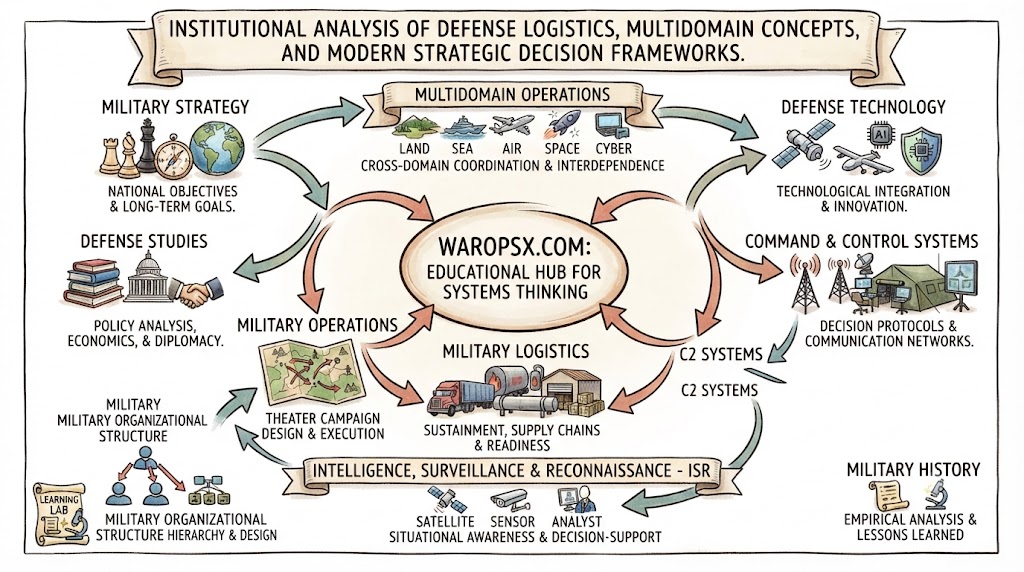
Contemporary military practitioners confront an operational landscape where sheer platform tallies offer zero guarantee of strategic success, because geopolitical volatility, digital interconnectivity, and institutional friction rapidly reshape theater realities. Nations achieve credible security posture only when planners synchronize core strategy, deliberate campaign design, industrial supply chains, resilient command channels, breakthrough technologies, fused intelligence feeds, streamlined organizational hierarchies, and integrated operations across land, sea, air, space, and cyberspace. Dissecting defense machinery as an interdependent ecosystem transforms raw data into actionable knowledge, enabling analysts to evaluate institutional posture beyond isolated equipment benchmarks, which makes WarOpsX.com an indispensable academic destination for defense enthusiasts, university scholars, and security analysts examining the organizational mechanisms governing modern defense affairs.
What Is WarOpsX.Com?
WarOpsX.com provides an open academic portal that deconstructs the operational architecture of global defense systems by analyzing strategic doctrines, logistical sustainment grids, command communications, and technological integration through an objective, research-driven curriculum. Built to serve political science undergraduates, military historians, policy researchers, and defense technology specialists, this educational repository strips away battlefield tactics and weapons-handling procedures to emphasize structural doctrine, institutional design, and policy execution. Learners use the site to evaluate how state objectives translate into theater capabilities, how institutional hierarchies enforce command integrity, and how emerging technological innovations alter foundational military theory.
What Does WarOpsX.Com Cover?
The curriculum spans fundamental defense pillars to furnish researchers with an exhaustive perspective on national security establishments and defense institutions. Central subject areas include military strategy, multidisciplinary defense studies, operational planning, industrial logistics, command structures, disruptive technologies, analytical military history, unit organization, multidomain synchronization, and intelligence ecosystems. Instead of presenting these disciplines in isolated silos, the platform maps the connective tissue linking political mandates to operational sustainment, technological acquisition, and headquarters command structures.
Military Strategy
Military strategy translates overarching state policy into executable defense capability, guiding how governments prioritize defense spending, evaluate foreign threat environments, construct credible deterrence frameworks, and prepare for institutional competition. While tactical actions dictate immediate field clashes and operational campaigns organize regional movements, strategy establishes the fundamental purpose, political limits, and long-term security horizons that validate military power. Novice observers frequently equate strategic posture with localized battlefield victories, yet strategy demands sober risk balancing, industrial resource mobilization, and sustainable policy coordination across decades.
Defense Studies
Defense studies functions as a multidisciplinary domain uniting international diplomacy, statecraft, economics, physical geography, organizational sociology, and technological history into an integrated field of analysis. Focusing exclusively on platform inventories blinds analysts to the legislative pressures, fiscal limits, industrial supply bases, and diplomatic pacts that ultimately determine whether a military establishment achieves its goals. By studying defense establishments as complex social and political institutions, scholars accurately interpret sovereign state behavior, assessing how geographic borders, natural resource dependencies, and institutional culture shape national security choices.
Military Operations
Bridging national strategy and localized unit engagements, the operational level orchestrates campaigns, directs theater asset movement, maintains force readiness, and aligns dispersed service elements toward clear strategic end-states. Operational planners align joint movement schedules, secure critical lines of communication, and synchronize theater movements under severe operational friction without engaging in individual unit tactics. Grasping this intermediary sphere shows researchers how abstract national aims materialize as synchronized theater campaigns, demonstrating the institutional synchronization required to sustain large-scale momentum over extended timeframes.
Military Logistics
Logistics establishes the true ceiling of institutional readiness, maintaining supply chains, heavy maintenance yards, fuel transport, medical corridors, warehouse distribution hubs, ammunition depots, and repair infrastructure. Even advanced strike aircraft and armored task forces rapidly grind to an absolute standstill whenever maintenance schedules lapse, depot deliveries fail, or supply corridors close due to infrastructure breakdowns. For example, when an armored division advances faster than its fuel and replacement-parts convoys can travel, crews abandon operational tanks along roadways entirely because transport pipelines snapped rather than from adversary resistance.
Command and Control Systems
Command and control systems establish the formal authorities, communications channels, data networks, and decision-making protocols that empower leadership to guide personnel across contested operational environments. The core architecture follows an iterative operational loop wherein raw information informs analytical assessment, guiding leadership decisions that prompt clear directives, field execution, and rapid operational feedback loops. Modern commands require both resilient digital hardware and sound organizational design, ensuring that commanders retain clear situational awareness and institutional accountability even when electronic interference disrupts primary data links.
Defense Technology
Disruptive developments—such as machine-learning analytics, uncrewed systems, multispectral sensor arrays, hardened communications protocols, physics-based simulations, and cyber operations—transform modern operational tempos and leadership deliberations. However, introducing cutting-edge platforms never corrects underlying institutional dysfunction by itself, because advanced technology requires exhaustive personnel training, transparent governance frameworks, cross-service interoperability, diligent maintenance schedules, and meaningful human oversight over automated data outputs. Sustainable defense institutions balance rapid technical innovation with disciplined cyber defense and strict data governance to ensure that emerging tools directly reinforce strategic objectives.
Military History
Military history offers defense scholars an expansive repository of empirical evidence, illustrating how historical states, institutions, and leaders managed systemic friction, material scarcity, diplomatic realignments, and sudden technological shifts. Conceptual analysis of historical campaigns—rather than rote memorization of battle dates or equipment statistics—uncovers enduring truths regarding supply chain vulnerability, organizational inertia, cognitive blind spots, and institutional adaptation under duress. Interrogating the past through an analytical lens empowers modern defense researchers to recognize systemic vulnerabilities, challenge dogmatic assumptions, and avoid repeating the organizational blunders that dismantled historical security alliances.
Military Organizational Structure
Military organizational design establishes the clear hierarchies, headquarters staffs, joint commands, service components, and unit formations that preserve administrative accountability across expansive defense establishments. Transparent organizational architecture defines lines of authority, eliminates bureaucratic friction, streamlines resource allocation, and expedites information transmission between ministerial planners and field formations. Without well-defined command relationships and clear divisions of responsibility, defense establishments suffer from fragmented coordination, severe communications latency, institutional infighting, and decision paralysis during national security crises.
Multidomain Operations
Multidomain operations address the complex reality that modern operating theaters no longer permit isolated service actions, requiring tight synchronization across the land, sea, air, space, cyber, and information domains. A single cyber disruption against an offshore communications relay can sever naval data conduits, blind early-warning radar arrays, and degrade orbital reconnaissance passes simultaneously. Researching multidomain doctrine emphasizes cross-domain dependencies, shared digital architectures, and collaborative operational planning over service-specific, single-environment maneuvers.
Intelligence, Surveillance and Reconnaissance
Intelligence, Surveillance, and Reconnaissance (ISR) frameworks govern the continuous information cycle—spanning systematic collection, automated data collation, expert contextual analysis, threat assessment, and dissemination—that provides decision-makers with vital situational awareness. Raw observations gathered by orbital constellations, uncrewed surveillance aircraft, radar systems, and digital networks provide zero utility until trained intelligence analysts verify source reliability, filter sensor clutter, and evaluate strategic context. Rather than disclosing operational tradecraft, academic examination of ISR clarifies how intelligence directorates minimize analytical bias, assess strategic ambiguity, and deliver reliable decision support to leadership.
How Military Strategy, Operations, Logistics and Technology Connect
Comprehensive defense research treats these core disciplines as an integrated, living system: national strategy establishes ultimate goals, operational planners organize collective assets, organizational structures assign responsibilities, logistics sustains durability, technology extends reach, and information streams empower leadership direction. When defense ministries outline strategic goals without evaluating logistical pipelines, operational plans inevitably collapse from supply exhaustion; similarly, adopting advanced hardware without upgrading organizational structures creates administrative friction and vulnerabilities. Recognizing how each domain depends entirely on the operational health of the others allows researchers to evaluate genuine institutional capability rather than relying on superficial, isolated defense metrics.
Mastering this interconnected ecosystem requires an understanding of how each functional discipline contributes to overall defense capability:
- Military Strategy: Focuses on national security objectives and long-term planning, connecting defense capabilities directly with political goals.
- Defense Studies: Encompasses security policy, international relations, economics, and history to deliver a multidisciplinary foundation for defense analysis.
- Military Operations: Covers campaign design, joint coordination, and theater planning, translating high-level strategic guidance into coordinated field capability.
- Military Logistics: Manages supply chains, infrastructure, maintenance, and sustainment, guaranteeing operational readiness and operational longevity.
- Command and Control: Establishes authority structures, communication networks, and decision cycles, preserving operational direction, accountability, and coordination.
- Defense Technology: Integrates artificial intelligence, cyber architecture, and advanced sensors, expanding institutional capabilities and altering operational tempo.
- Military History: Analyzes past operational campaigns, institutions, and doctrine to supply vital analytical context and timeless organizational lessons.
- Organizational Structure: Outlines hierarchy, functional commands, and joint force design, establishing institutional clarity, communication, and discipline.
- Multidomain Operations: Coordinates activities across land, maritime, air, space, and cyber, synchronizing joint action across modern operating domains.
- ISR: Directs information collection, data processing, and analytical support, building continuous situational awareness and mitigating strategic uncertainty.
Real-Life Scenarios / Experiences
- Port infrastructure limits halt a joint disaster-relief mission when maritime transports deliver cargo that local shore cranes cannot lift, proving that advanced command plans fail whenever physical logistics networks lack basic compatibility.
- An automated air-surveillance cell overwhelms radar operators with thousands of unprocessed sensor alerts during an exercise, showing that unfiltered data collection blinds leadership unless analysts establish clear information processing gates.
- Incompatible communication protocols between ground units and air wings cause complete tactical data blackouts during a combined-arms drill, illustrating that sophisticated hardware degrades command control if engineers fail to build cross-service interoperability.
- A national ministry purchases advanced fighter squadrons but underfunds maintenance depot contracts and technician pipelines, forcing ground crews to cannibalize parts and grounding airframes despite substantial capital acquisition spending.
How to Use WarOpsX.Com for Structured Learning
- Step 1: Examine core defense studies concepts to understand how international relations, economic systems, and strategic culture shape sovereign defense policy.
- Step 2: Investigate military strategy frameworks to comprehend how defense ministries balance risk, construct deterrence models, and align military capabilities with foreign policy goals.
- Step 3: Analyze military organizational structures to understand how command hierarchies, staff sections, and service branch models allocate authority across large institutions.
- Step 4: Explore operational-level campaign planning to see how joint staffs translate political directives into synchronized, theater-wide maneuvers.
- Step 5: Study military logistics pipelines to evaluate how fuel networks, spare-parts distribution, depot maintenance, and transport infrastructure sustain overall readiness.
- Step 6: Review command systems and emerging defense technologies to understand how digital networks, artificial intelligence, and robust sensor suites empower leadership decision cycles.
- Step 7: Synthesize your analysis using historical case studies and multidomain frameworks to track the interplay between land, sea, air, space, and cyber forces during crises.
Who Can Benefit From WarOpsX.Com?
- University students pursuing international affairs, strategic studies, and political science degrees who require clear conceptual models to interpret defense policy.
- Think-tank researchers and defense analysts looking for structured reference materials covering institutional structures, theater operations, and multidomain integration.
- History scholars seeking to move past superficial battle chronologies to investigate the logistics pipelines, administrative systems, and strategic doctrines that drove historical outcomes.
- Public administration specialists and budget analysts who require a firm grasp of military terminology, readiness metrics, and procurement realities to evaluate national security spending.
- Software developers, systems engineers, and aerospace technicians designing defense hardware who seek foundational knowledge of operational environments and command hierarchies.
- Defense enthusiasts and independent researchers searching for an academic, system-level curriculum that discards sensationalism to explain the organizational mechanics of defense power.
Why Understanding Defense as a System Matters
Sovereign defense establishments function as complex socio-technical systems wherein strategic performance emerges from continuous interactions among leadership, organizational structure, equipment reliability, logistical sustainment, transport infrastructure, and institutional agility. Equating national military power with mere hardware tallies produces dangerous strategic blind spots, encouraging observers to disregard the transport grids, software architectures, repair depots, and command decisions that generate real capabilities. WarOpsX.com advances an integrated systems-thinking curriculum, teaching analysts, researchers, and students to evaluate defense establishments as living networks that succeed or fail based on structural balance and organizational cohesion.
Common Mistakes to Avoid
- Confusing strategic state goals with tactical battlefield actions, leading analysts to interpret local engagements as broad geopolitical achievements.
- Assessing military strength strictly through platform tallies while completely ignoring maintenance backlogs, supply chains, and personnel readiness rates.
- Expecting technical innovations to rescue organizations that suffer from fractured communication channels, poor leadership structures, or outdated operational doctrine.
- Treating operational domains—such as land, maritime, air, space, and cyber—as standalone theaters rather than recognizing their deep operational interdependence.
- Disregarding the decisive impact of terrain, transit corridors, and domestic industrial capacity when judging the sustainability of military campaigns.
- Memorizing battle dates, commanders, and casualty figures without analyzing the supply constraints, command decisions, and organizational adjustments that produced those results.
- Believing that broad sensor deployment automatically produces actionable intelligence, forgetting that raw surveillance requires disciplined analytical processing to yield true situational awareness.
- Overlooking administrative command structures, underestimating how overlapping operational boundaries and jurisdictional confusion paralyze decision-making during fast-moving emergencies.
Frequently Asked Questions
1. What is the difference between military strategy and military tactics?
Strategy establishes high-level national security goals, allocates budgets, assesses international risks, and marshals national resources to achieve political objectives. Tactics, conversely, govern the localized movement, positioning, and technical methods that units employ during immediate field engagements. Strategy determines the overarching political purpose of military activity, while tactics execute physical actions within a specific battlespace.
2. Why is military logistics considered the foundation of organizational readiness?
Logistical pipelines dictate whether military forces can deploy, sustain, and maneuver their assets over extended operational timelines. Without regular shipments of fuel, ammunition, medical equipment, and replacement parts, combat units quickly lose mobility and combat power. Neglecting logistics degrades readiness, leaving sophisticated platforms abandoned whenever distribution networks fail.
3. How do command and control systems support decision-making during crises?
Command and control frameworks provide reliable communication channels, clear lines of authority, and situational awareness tools that allow commanders to process crisis data rapidly. By establishing a structured sequence from data collection to analysis, direction, and feedback, these networks eliminate organizational friction. They guarantee that leadership directives reach field commanders without ambiguity.
4. What is the role of artificial intelligence in modern defense environments?
Machine-learning applications process massive sensor streams, identify operational anomalies, optimize complex supply chains, and automate administrative tracking across defense enterprises. These digital capabilities reduce cognitive strain on staff officers during high-tempo operations. However, AI applications remain decision-support tools that require human oversight, clean data inputs, and strict governance to ensure reliable operations.
5. Why should defense studies students examine military history analytically?
Analyzing past campaigns allows students to observe how institutional friction, geography, logistical choke points, and doctrinal assumptions shape crisis outcomes. Instead of memorizing battle dates, students identify timeless patterns of organizational failure, strategic miscalculation, and successful adaptation. This historical analysis provides a grounded foundation for evaluating modern security dilemmas.
6. What does multidomain operations mean in practice?
Multidomain operations require armed forces to synchronize operations across the land, maritime, air, space, cyber, and information domains simultaneously. In practice, maneuvers within one domain create openings or provide protection in another, such as cyber units defending satellite communication links for naval task forces. This doctrine requires shared communication networks and joint planning.
7. How does intelligence differ from surveillance and reconnaissance?
Surveillance provides persistent monitoring over designated geographic regions, while reconnaissance executes focused, mission-specific tasks to collect specific observational data. Intelligence represents the evaluated analytical product that specialists assemble after synthesizing, cross-referencing, and contextualizing that raw observational data. Unprocessed sensor collections do not constitute intelligence until rigorous analysis provides operational meaning.
8. Why is organizational structure so critical for defense ministries and militaries?
Clear organizational design establishes clear lines of authority, delineates command responsibilities, and prevents administrative confusion during national crises. Transparent command relationships ensure rapid communication between political leaders and operational commanders while streamlining resource distribution. Without institutional clarity, military establishments experience bureaucratic inertia, inter-service friction, and delayed operational responses.
9. Can high-technology weapons systems compensate for weak strategic planning?
Advanced technology cannot rescue campaigns that rest on faulty strategic premises, vague political goals, or fragile logistics networks. When political-military leaders misjudge regional geopolitical dynamics or economic realities, modern hardware merely postpones strategic failure rather than preventing it. Sound strategy remains the ultimate arbiter of defense success, while technology functions strictly as an enabler.
10. Who should consider reading educational materials on defense systems?
Educational defense analysis assists university students in international relations, public policy analysts reviewing defense budgets, software engineers building aerospace systems, and military historians. It also benefits informed citizens who wish to understand defense policy, force readiness, and geopolitical developments. These resources deliver the analytical vocabulary needed to evaluate defense affairs objectively.
11. How do supply chain bottlenecks influence long-term national security?
Supply chain vulnerabilities undermine an institution's capacity to maintain equipment fleets, manufacture replacement ordnance, or deploy units during extended crises. When defense industrial bases depend on single-source suppliers or vulnerable shipping lanes, readiness rates deteriorate across all branches. Long-term defense posture relies as heavily on resilient manufacturing and stockpiles as on active force numbers.
12. What is the primary purpose of studying defense as an interconnected system?
Evaluating defense as an interconnected system prevents researchers from relying on superficial metrics, such as raw vehicle counts or aircraft inventories, to judge capability. It reveals how political direction, logistical pipelines, communications networks, and technological tools interact to generate genuine operational readiness. This holistic approach helps analysts identify institutional vulnerabilities across entire defense establishments.
Conclusion
Examining sovereign security requires an appreciation of defense as a holistic system, where genuine understanding demands far more than tallying hardware inventories or memorizing historical conflicts. Comprehensive insight emerges when researchers systematically evaluate how national strategy, theater operations, logistical supply lines, command channels, and emerging technologies operate as an integrated whole. Educational platforms assist students and analysts in navigating this institutional complexity by presenting defense concepts within clear, objective frameworks that connect political goals with practical sustainment. Embracing this systems-thinking approach empowers scholars to assess national defense capabilities objectively and navigate the complex strategic realities shaping our global security landscape.