DevOps Certified Professional (DCP) Curriculum Standards For Real World Cloud Automation Roles
Introduction
Modern engineering teams demand hands-on technical validation rather than paper credentials when hiring for infrastructure roles. Engineering leaders increasingly expect candidates to exhibit the same architectural rigor seen in elite multi-cloud programs before trusting them with live distributed environments. This actionable analysis equips software builders, systems administrators, reliability engineers, and technical leadership with a candid assessment of automated platform competencies. Establishing verifiable credibility in deployment automation requires concrete operational mastery over abstract concepts.
Career plateaus often frustrate experienced engineers when organizations replace legacy infrastructure with declarative internal developer platforms and containerized microservices. This comprehensive guide examines how performance-based assessments validate day-to-day engineering competence. Studying this roadmap will guide your professional development into high-impact systems architecture and platform reliability domains.
What is the DevOps Certified Professional (DCP)?
The DevOps Certified Professional (DCP) establishes an industry standard that measures an engineer’s capacity to construct, secure, and operate automated delivery ecosystems under production conditions. It addresses a fundamental enterprise failure mode: hiring individuals who understand theoretical abstractions yet fail when debugging broken live environments. The standard emphasizes execution speed, immutable infrastructure practices, and declarative resource definitions.
High-throughput consumer platforms require zero tolerance for unmonitored configuration drift and flaky continuous integration pipelines. This evaluation model directly mirrors the operational cadences of enterprise platforms by testing your command over telemetry, container runtimes, and platform APIs. It aligns candidate knowledge directly with the daily practices of mature technology organizations.
Who Should Pursue DevOps Certified Professional (DCP)?
Infrastructure specialists, backend programmers, and deployment leads who want to escape manual patching routines will gain immediate traction from this program. Platform specialists and reliability teams can use this framework to validate cross-cutting infrastructure design skills across enterprise networks. The coursework equally assists system operators seeking formal validation of their automated scripting skills.
Engineering directors and operations leads benefit from this baseline because modern leadership requires an intimate understanding of automated delivery failure domains. Technology firms across India, North America, and Europe actively compete for practitioners who bring cohesive deployment methodologies to their teams. The program equips every participant to eliminate manual operational waste across enterprise delivery cycles.
Why DevOps Certified Professional (DCP) is Valuable in the Modern Era and Beyond
Tooling ecosystems shift continuously, yet the underlying architectural mechanics of distributed networks, telemetry ingestion, and containerization remain durable career assets. This program builds resilience against tool fatigue by grounding your skills in core platform patterns rather than proprietary commercial interfaces. You learn how to evaluate system performance and maintain production reliability irrespective of the underlying cloud provider.
Companies actively reward engineers who accelerate release frequency while driving down production failure rates and MTTR metrics. Achieving this qualification proves to technical interview panels that you can enter a software organization and improve deployment reliability immediately. It transforms your career by proving you write clean, auditable platform automation code that protects company uptime.
DevOps Certified Professional (DCP) Certification Overview
The DevOps Certified Professional (DCP) uses practical, scenario-based evaluations that require candidates to build, troubleshoot, and repair realistic platform automation environments. Instead of relying on passive memorization drills, the testing environment presents realistic failure modes that demand active terminal proficiency. You must show how you write maintainable infrastructure files, isolate pipeline bottlenecks, and secure deployment configurations.
The assessment tests your ability to translate high-level infrastructure designs into functioning configuration management routines and cluster manifests. You demonstrate competence across declarative deployments, version control branching, and automated release rollback strategies. This rigorous assessment gives hiring managers confidence that certified practitioners will preserve system availability during critical production rollouts.
DevOps Certified Professional (DCP) Certification Tracks & Levels
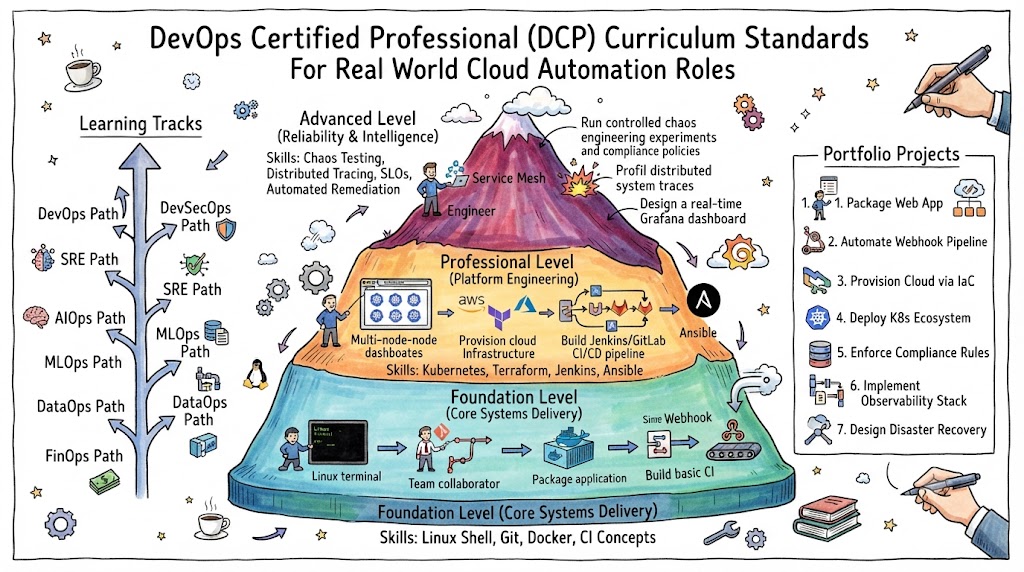
The curriculum features distinct developmental tiers that help engineers advance smoothly from foundational pipeline automation up to global infrastructure governance:
- Foundation Level: Covers core Linux process control, shell automation, Git repository management, network topologies, and simple continuous deployment triggers.
- Professional Level: Emphasizes production Kubernetes management, declarative cloud provisioning, configuration management engines, and continuous verification architectures.
- Advanced Level: Targets cross-region cloud failover strategies, internal developer platform design, deep compliance enforcement, and high-scale platform reliability engineering.
These levels connect directly with targeted industry domains like security engineering, financial cloud management, and automated telemetry platforms, giving you a custom roadmap tailored to your specific engineering goals.
Complete DevOps Certified Professional (DCP) Certification Table
The program organizes certifications across specialized tracks, specific levels, target audiences, prerequisite knowledge, and essential skills to establish a clear progression:
- Core DevOps Track (Foundation Level): Built for support staff and junior developers who possess shell scripting and basic terminal experience. This qualification covers Linux internals, Git workflows, and continuous integration build pipelines as the recommended first step in the learning sequence.
- Core DevOps Track (Professional Level): Designed for systems engineers and cloud administrators with two years of operational exposure. This second-stage certification focuses on deploying production Kubernetes clusters, authoring declarative infrastructure templates, and running automation playbooks.
- Core DevOps Track (Advanced Level): Tailored for lead architects and staff engineers who possess deep production infrastructure design experience. As the third stage in the sequence, it validates multi-region platforms, GitOps architectures, and service mesh networks.
- Site Reliability Track (Professional Level): Geared toward production support and site reliability teams with operating system administration backgrounds. Recommended as the fourth milestone, it focuses on Prometheus metrics, alert manager configurations, and chaos experiments.
- DevSecOps Track (Professional Level): Developed for cloud security specialists and audit engineers who understand container fundamentals. Placed fifth in the learning sequence, it covers container image vulnerability scanning, automated static code checks, and policy-as-code enforcement.
- FinOps Track (Professional Level): Crafted for technical leads and financial operations analysts with a baseline awareness of cloud billing architecture. Positioned sixth in the order, it develops skills in resource rightsizing, tagging enforcement, and automated cleanup of idle instances.
- DataOps Track (Professional Level): Aimed at data platform engineers with working experience in Python and relational database engines. Recommended as the seventh sequence step, it covers schema migration pipelines, automated data tests, and data version control.
- AIOps Track (Advanced Level): Targeted at telemetry leads and platform architects who manage enterprise observability stacks. Standing eighth in the path, it develops competencies in algorithmic log filtering and metric anomaly detection engines.
- MLOps Track (Advanced Level): Formulated for machine learning platform engineers who build containerized Python deployments. As the final milestone, it covers model registry management, Kubeflow pipelines, and model drift alerts.
Detailed Guide for Each DevOps Certified Professional (DCP) Certification
DevOps Certified Professional (DCP) – Foundation Level
What it is
This credential validates essential engineering competencies across Linux administration, collaborative version control patterns, and fundamental deployment automation. It proves that an engineer can navigate command-line environments, isolate pipeline failures, and support team delivery routines without introducing security vulnerabilities.
Who should take it
Junior operations analysts, support engineers, automated quality engineers, and entry-level coders looking to build a career in cloud infrastructure and automated release delivery.
Skills you’ll gain
- Administering secure Linux nodes, managing system systemd services, and drafting shell automation.
- Executing Git branching models, interactive rebases, and clean code integration workflows.
- Building automated continuous integration scripts that run test suites and manage build artifacts.
- Constructing basic container images while applying foundational security parameters.
Real-world projects you should be able to do
- Launch and configure a hardened Linux runner that executes build workloads safely.
- Write a pipeline configuration that automatically pulls code, executes integration tests, and generates deployable software packages.
- Organize a branch protection strategy that requires passing status checks before merging incoming code updates.
Preparation plan
- 7–14 days: Practice essential shell utilities, write bash loops, review Git mechanics, and assemble simple continuous integration scripts daily.
- 30 days: Set up local virtual machine instances, deploy simple web services, and replace manual administration steps with shell scripts.
- 60 days: Construct comprehensive home-lab continuous delivery workflows, automate unit test stages, and complete multiple timed infrastructure challenges.
Common mistakes
- Skipping Linux command-line practice in favor of web-based administrative consoles.
- Memorizing declarative pipeline templates without understanding process isolation boundaries.
- Neglecting essential operating system metrics including inode limits, file descriptors, and packet filtering rules.
Best next certification after this
- Same-track option: DevOps Certified Professional (DCP) – Professional Level
- Cross-track option: DevOps Certified Professional (DCP) – DevSecOps Professional
- Leadership option: Certified DevOps Team Lead
DevOps Certified Professional (DCP) – Professional Level
What it is
This benchmark verifies your ability to deploy and run resilient containerized workloads across declarative cloud infrastructure. It proves you can author robust infrastructure scripts, manage cloud-native clusters, and release application updates safely without production outages.
Who should take it
Practicing cloud engineers, systems administrators, full-stack builders, and site operations personnel who maintain live client-facing infrastructure and deployment systems.
Skills you’ll gain
- Authoring declarative infrastructure code to provision cloud networks, compute resources, and managed storage.
- Assembling lean, secure, multi-stage container files that eliminate build bloat.
- Operating production Kubernetes clusters, writing deployment controllers, and exposing network ingress points.
- Designing automated Canary and Blue-Green release flows that prevent service degradation during rollouts.
- Enforcing centralized server state and remediating configuration drift with automation playbooks.
Real-world projects you should be able to do
- Provision a complete, multi-tier cloud environment using modular declarative infrastructure configurations.
- Deploy an automated delivery pipeline that tests, builds, audits, and rolls out containerized microservices to Kubernetes clusters.
- Write automation playbooks that bring non-compliant server pools back to target configuration baselines automatically.
Preparation plan
- 7–14 days: Drill declarative infrastructure state management, Kubernetes network policies, and configuration management modules daily.
- 30 days: Configure sandbox clusters, deploy multi-container applications, and deliberately break pipeline stages to practice recovery.
- 60 days: Construct an enterprise-grade platform from scratch with automated secret management, canary deployment capabilities, and live cluster state synchronization.
Common mistakes
- Managing infrastructure components manually alongside automated code definitions, which inevitably introduces configuration drift.
- Storing unencrypted environment credentials, access tokens, and private keys within version control systems.
- Building oversized container images containing compilers and development packages that expand the attack surface.
Best next certification after this
- Same-track option: DevOps Certified Professional (DCP) – Advanced Level
- Cross-track option: DevOps Certified Professional (DCP) – SRE Professional
- Leadership option: Certified Platform Engineering Lead
DevOps Certified Professional (DCP) – Advanced Level
What it is
This qualification certifies top-tier technical leadership in distributed systems architecture, internal platform development, and cross-region disaster recovery operations. It validates your capacity to design highly resilient, observable platforms that process massive transactional traffic while maintaining enterprise governance standards.
Who should take it
Senior systems engineers, enterprise platform architects, and lead technical specialists who design mission-critical infrastructure architectures and guide cross-team platform strategies.
Skills you’ll gain
- Engineering active-active infrastructure architectures across multiple regions with dynamic DNS routing.
- Developing internal self-service developer portals that provide compliant computing resources on demand.
- Implementing advanced service mesh topologies that control mutual TLS, ingress routing, and fine-grained traffic shaping.
- Defining automated infrastructure compliance frameworks that satisfy stringent enterprise governance audits.
Real-world projects you should be able to do
- Build a multi-cluster service mesh architecture that manages traffic balancing and zero-trust communication across distinct clouds.
- Implement an automated failover engine that restores enterprise transactional capabilities within strict Recovery Time Objectives.
- Build a self-service platform API that enables application teams to provision standard production environments independently.
Preparation plan
- 7–14 days: Review distributed systems consensus protocols, network traffic engineering, and cross-region data synchronization strategies.
- 30 days: Build complex multi-cluster Kubernetes testbeds, inject network latency, and validate automated disaster recovery failover mechanisms.
- 60 days: Design an enterprise multi-cloud operational blueprint that integrates policy enforcement engines, service mesh networks, and resilient data layers.
Common mistakes
- Over-engineering cluster topologies with unnecessary abstractions that burden operational teams.
- Deploying service meshes across environments that lack the baseline observability needed to debug them.
- Validating disaster recovery plans through paper reviews rather than running live, disruptive simulations.
Best next certification after this
- Same-track option: Enterprise Platform Architect
- Cross-track option: DevOps Certified Professional (DCP) – AIOps Advanced
- Leadership option: Director of Platform Engineering / VP of Infrastructure
Choose Your Learning Path
DevOps Path
This pathway teaches you to streamline code flow from developer workstations to production clusters while improving overall platform stability. You master the craft of writing modular infrastructure code, optimizing container builds, and constructing automated delivery pipelines. The curriculum shows you how to remove deployment friction, enforce consistent runtime environments, and manage releases safely. It provides the core foundational skills for anyone looking to build a career in modern platform automation.
DevSecOps Path
This track embeds security validation directly into every phase of your automated delivery lifecycle. You learn how to run static security scanners, verify container image signatures, manage secrets lifecycles, and enforce policy-as-code guardrails. Rather than treating security checks as late-stage delivery roadblocks, this path shows you how to build fast, automated release gates that catch vulnerabilities early. It equips you to safeguard production environments without slowing your team's release velocity.
SRE Path
The Site Reliability Engineering curriculum focuses on system resilience, incident handling, and platform scaling. You master the mathematics of service level indicators, balance error budgets against feature releases, and run controlled chaos experiments. The course details telemetry architectures, distributed tracing, and automated self-healing platform design. It is the ideal path for practitioners who want to protect enterprise uptime across complex, distributed production systems.
AIOps Path
This learning path explores machine intelligence to optimize platform telemetry, log analytics, and production incident response. You master event correlation tools, automated root-cause detection engines, and metric anomaly detection platforms. The coursework shows you how to cut through alert noise and direct engineer attention straight to genuine system issues. It builds the specialized operational skills needed to run high-throughput platforms that exceed human monitoring capacity.
MLOps Path
The MLOps specialization addresses the specific operational hurdles of packaging, tracking, and serving machine learning models in production. You learn how to build reproducible training pipelines, track feature drift, manage model version registries, and run canary rollouts for predictive services. This track turns experimental machine learning scripts into resilient, monitored inference microservices. It is built specifically for platform engineers who support enterprise data science groups.
DataOps Path
The DataOps track brings automated deployment practices and quality validation into enterprise data platform engineering. You learn how to apply continuous integration to data transformations, automate schema migration checks, and orchestrate complex data pipelines safely. The lessons emphasize automated data quality testing and repeatable analytical environments. It enables data teams to ship reliable, high-performance data streams while eliminating manual pipeline interventions.
FinOps Path
This curriculum unites infrastructure architecture with financial accountability across modern cloud platforms. You master automated resource tagging frameworks, compute rightsizing playbooks, and automated routines that clean up orphaned resources. The track shows you how to build self-service cost reporting dashboards that give engineering teams real-time visibility into their cloud spend. It is designed for engineers and platform managers who want to drive down cloud bills while maintaining system performance.
Role → Recommended DevOps Certified Professional (DCP) Certifications
Aligning your professional goals with targeted credentials maximizes your operational impact and establishes focused subject matter expertise:
- DevOps Engineer: Requires completing the DCP Professional and DCP Advanced certifications, concentrating on building automated delivery pipelines, writing declarative infrastructure code, and administering Kubernetes clusters.
- Site Reliability Engineer (SRE): Targets the DCP Professional and DCP SRE tracks, with a dedicated operational focus on telemetry systems, service level objective frameworks, and automated disaster recovery.
- Platform Engineer: Demands completing the DCP Professional and DCP Advanced tracks, centering efforts on building internal developer portals, standardizing deployment tooling, and scaling container platforms.
- Cloud Engineer: Calls for pursuing the DCP Foundation and DCP Professional certifications to master cloud network provisioning, serverless automation, and baseline infrastructure security.
- Security Engineer: Demands the DCP Professional and DCP DevSecOps tracks, emphasizing automated vulnerability scanning, policy-as-code guardrails, and centralized secrets vaults.
- Data Engineer: Involves the DCP Foundation and DCP DataOps tracks to master automated testing for data transformations, schema migration checks, and reliable pipeline execution loops.
- FinOps Practitioner: Focuses on the DCP Foundation and DCP FinOps tracks, prioritizing cloud cost transparency, compute rightsizing, and automated tagging enforcement rules.
- Engineering Manager: Benefits most from the DCP Foundation and DCP Leadership tracks, developing a firm command over delivery velocity tracking, team platform designs, and production quality gates.
Next Certifications to Take After DevOps Certified Professional (DCP)
Same Track Progression
Completing the foundational and professional tiers positions you to tackle sophisticated enterprise platform challenges. Advanced study centers on running large-scale multi-cluster environments, building custom operators, and designing internal developer platforms that serve hundreds of engineers. At this level, your daily work shifts from maintaining individual platform components to building cohesive platforms that unlock team delivery velocity.
Cross-Track Expansion
Broadening your core operational skill set across adjacent domains creates a highly versatile engineering profile. Combining your core delivery knowledge with SRE or DevSecOps credentials helps you evaluate technical trade-offs from multiple operational angles. Learning how to integrate security policies and observability frameworks into your deployment pipelines makes you a far more effective systems designer.
Leadership & Management Track
Moving into technical management or staff-level architecture roles requires a shift toward business impact and delivery health. Pursuing leadership credentials helps you move beyond hands-on terminal tasks to evaluating system complexity, retiring legacy debt, and building sustainable team workflows. This training shows you how to structure technical teams, justify platform investments, and lead complex cloud migration initiatives.
Training & Certification Support Providers for DevOps Certified Professional (DCP)
DevOpsSchool
This provider delivers hands-on, enterprise-focused technical training geared toward practical, production-ready outcomes. Their curriculum emphasizes real-world platform scenarios, guiding engineers through modern continuous delivery pipelines, complex container clusters, and declarative infrastructure code. Learners gain hands-on access to lab environments that mirror the everyday architecture of high-traffic production platforms. The platform's mentoring model supports working professionals through real-world deployment challenges, helping them build practical problem-solving skills that translate directly to team workflows.
Cotocus
Cotocus offers structured technical enablement designed to align modern software engineering teams with scalable cloud infrastructure. Their programs focus on bridging knowledge gaps across platform orchestration, distributed build pipelines, and automated cloud environments. By emphasizing practical implementation over abstract lectures, they give candidates direct exposure to the operational patterns used across enterprise ecosystems. Their technical mentors focus on resolving day-to-day delivery bottlenecks, teaching engineers how to write maintainable automation code and build reliable release gates.
Scmgalaxy
Scmgalaxy provides a deep community-driven knowledge base and structured training tracks focused on configuration management, version control design, and continuous integration pipelines. The platform curates learning materials around the practical nuances of deployment automation, software build engineering, and toolchain integration. Engineers benefit from their extensive repositories of workflows, configuration samples, and troubleshooting guides. Their programs help professionals transition smoothly from traditional system administration into modern platform and release engineering roles.
BestDevOps
BestDevOps focuses on curating up-to-date industry resources, operational guides, and specialized roadmaps for platform engineers and automation specialists. Their content breaks down modern enterprise delivery patterns, highlighting effective strategies for container adoption, microservice monitoring, and infrastructure-as-code maintenance. The platform helps engineers stay current with shifting open-source tooling, offering clear, opinionated reviews of automation frameworks. Their materials assist candidates in validating their day-to-day skills and building the foundational habits needed for professional certification.
devsecopsschool.com
This specialized training platform focuses entirely on integrating defensive security controls into continuous delivery pipelines. Their coursework covers automated vulnerability scanning, container image verification, dynamic testing orchestration, and policy-as-code frameworks. By contextualizing security within automated release cycles, they train engineers to build robust guardrails that safeguard production without slowing delivery velocity. The platform's labs teach developers and security teams how to collaborate effectively across shared pipelines.
sreschool.com
Dedicated to the operational disciplines of Site Reliability Engineering, this provider builds technical fluency around system resilience, incident handling, and telemetry design. Their courses focus on defining actionable service level objectives, instrumenting distributed systems, tracking error budgets, and conducting chaos experiments. Engineers work through real-world outage simulations, learning how to isolate system faults, orchestrate rapid mitigation, and run effective blameless post-mortems. The training helps organizations build sustainable reliability practices across complex distributed architectures.
aiopsschool.com
Aiopsschool addresses the intersection of artificial intelligence and systems operations, preparing engineers to manage large-scale telemetry using algorithmic analysis. The curriculum focuses on anomaly detection across distributed metric streams, automated alert triage, and intelligent event correlation platforms. Engineers learn how to reduce alert noise and build self-healing operational patterns that remediate common failure modes automatically. The platform helps forward-looking operations teams transition from manual monitoring routines toward automated, data-driven system oversight.
dataopsschool.com
This platform applies continuous delivery and agile engineering principles to modern data platform infrastructure. The curriculum addresses the operational hurdles of managing data quality, schema migrations, and distributed ETL pipelines with automated testing. Engineers learn to treat data pipelines with the same engineering discipline as software code, implementing automated regression tests, pipeline versioning, and environment sandboxing. Their courses help data engineers build reliable, production-ready data pipelines that scale safely.
finopsschool.com
Finopsschool focuses on the operational framework of cloud financial management, bridging the gap between engineering decisions and infrastructure costs. Their programs show technical teams how to monitor, allocate, and optimize cloud spending through automated guardrails, right-sizing routines, and utilization tracking. By treating cost efficiency as a core architectural metric alongside performance and availability, the platform trains engineers to design lean, budget-conscious cloud systems without compromising reliability or scalability.
Frequently Asked Questions (General)
1. Which performance parameters make these practical exams so demanding?
Examiners present active sandbox environments that require candidates to diagnose and resolve actual system failures under strict countdown clocks. Rote memorization of multiple-choice dumps yields zero value in this setting; you must author functioning automation scripts, correct broken pipeline configurations, and re-establish network reachability across live virtual machines.
2. How should an employed engineer schedule their weekly study hours?
Candidates typically reserve between five and ten hours each week over a comprehensive eight-week preparation timeline. Practitioners who manage Kubernetes clusters, author infrastructure templates, and maintain delivery pipelines in their daily roles often compress this duration by targeting specific knowledge gaps.
3. Which foundational skills must candidates secure before attempting the test?
You must demonstrate practical competence in Linux terminal environments, understand operating system networking rules, and draft shell scripts fluidly. You also require complete command over distributed version control workflows in Git, including rebasing, resolving merge conflicts, and configuring branch policies.
4. How does acquiring this credential improve marketability in the industry?
Earning this credential demonstrates to hiring managers that you possess the hands-on capability to maintain production infrastructure from your first day on the job. It accelerates technical screening processes by confirming your practical operational fluency in modern platform engineering and continuous delivery pipelines.
5. Which criteria determine how the evaluation platform scores candidates?
Automated testing suites inspect the final operational state of your assigned cloud environment once time expires. The verification tools confirm whether your continuous integration pipelines execute cleanly, your container workloads run securely, and your provisioned infrastructure matches the desired declarative configuration.
6. For what duration does this professional credential maintain active status?
The certification carries full validity for three consecutive years from the official examination completion date. You retain active certification standing by clearing the updated assessment version or advancing to a higher technical specialization.
7. Can practitioners without traditional software development backgrounds succeed here?
Systems operators, quality automation analysts, and network administrators make this career transition on a regular basis. You must write configuration manifests and administrative automation scripts, but you do not need commercial software engineering experience to succeed in this track.
8. In what order should candidates approach these distinct specializations?
Begin by consolidating core system administration, Git workflows, and deployment automation via the foundational tier. After conquering that core baseline, complete the professional track before selecting advanced specializations in DevSecOps, SRE, or FinOps based on your target career goals.
9. Do multinational technology enterprises recognize this professional credential?
Engineering teams across global technology markets place high value on credentials that rigorously evaluate open-source tools like Linux, Docker, Kubernetes, and Terraform. The practical skills tested in these evaluations apply directly to enterprise cloud environments worldwide.
10. What hardware configuration will candidates need to build an effective home laboratory?
A standard personal computer with sixteen gigabytes of RAM and four processing cores easily hosts local container engines, virtualization tools, and single-node Kubernetes setups. You can tackle multi-node and advanced scenarios by taking advantage of free tiers offered by major public cloud platforms.
11. How does a vendor-neutral qualification differ from single-cloud platform exams?
Proprietary vendor certifications examine specific administrative consoles and bespoke managed cloud services. In contrast, comprehensive credentials evaluate your ability to link open-source tools and multi-cloud services into a reliable, vendor-neutral delivery engine.
12. In what way does this curriculum assist engineering leadership?
Technology managers gain direct insight into the everyday deployment hurdles, pipeline inefficiencies, and security constraints that platform engineers encounter daily. This technical context allows managers to make sharper architectural choices, estimate platform investments accurately, and eliminate delivery bottlenecks across teams.
FAQs on DevOps Certified Professional (DCP)
1. Which specific practical capabilities separate this credential from generic offerings?
Candidates face scenario-driven challenges requiring them to draft working automation code, repair failing build pipelines, and maintain live platform nodes directly inside a terminal. You must prove your hands-on mastery over infrastructure provisioning languages, container deployment manifests, and zero-downtime release routines under realistic time pressures. This deliberate emphasis assures enterprise employers that you can safely handle complex production infrastructure immediately.
2. Can seasoned infrastructure engineers test into the Professional tier directly?
Engineers who possess over two years of hands-on experience running Linux operating systems, cloud networking, and continuous integration engines can bypass the foundational level. However, reviewing the foundation syllabus remains highly beneficial to confirm you harbor no subtle gaps in core automation mechanics.
3. Which precise container orchestration challenges appear within the practical examination?
The testing console requires you to compose declarative deployment files, set up ingress controllers, attach persistent storage volumes, and assign least-privilege service permissions. Candidates must also troubleshoot unhealthy pods, implement rolling deployment strategies, and manage blue-green traffic splits under strict time limits.
4. In what manner does the testing suite evaluate Infrastructure as Code capabilities?
Candidates write declarative infrastructure code to provision cloud networks, configure compute instances, and establish managed identity rules. The testing platform verifies that your scripts build reproducible infrastructure modules and maintain clean state management without introducing configuration drift.
5. How much time do candidates receive to finish the practical examination?
The platform grants candidates three full hours inside a remotely proctored browser window linked to active virtual command-line interfaces. You interact with live sandbox infrastructure to troubleshoot failing pipelines, deploy services, and fulfill assigned automation goals.
6. Does the examination curriculum incorporate automated defensive security measures?
Candidates encounter security checkpoints woven directly into the core deployment pipelines. You must integrate automated static code analysis checks, scan container images for vulnerable binaries, secure secrets using dedicated vaults, and apply strict access policies across application deployment manifests.
7. In what way can candidates without access to enterprise infrastructure prepare adequately?
You can configure complete learning environments on a personal computer using virtual machines, lightweight container engines, and local Kubernetes instances. Building and automating a multi-tier web application from scratch provides the hands-on operational practice you need to pass the performance-based exam.
8. Which documentation resources can candidates consult during the live exam?
Testing consoles allow direct access to official documentation portals for open-source utilities like Kubernetes, Terraform, and Ansible within the browser window. The examination evaluates your capacity to apply systems design principles and solve operational incidents rather than your memory of command-line switches.
Final Thoughts: Is DevOps Certified Professional (DCP) Worth It?
Investing career resources into technical accreditations requires hard-headed calculation of tangible professional returns. Credentials based solely on multiple-choice questions offer minimal reassurance to hiring teams during technical evaluations or live outages. Principal engineers and hiring managers immediately spot the difference between individuals who rely on paper qualifications and those who possess real operational capability.
The DevOps Certified Professional (DCP) program provides undeniable career momentum by verifying your hands-on execution speed on live terminals. If you seek to move past brittle, manual deployment habits and construct resilient, scalable platform systems, this curriculum provides an organized, demanding pathway. Approach this certification as a deliberate commitment to mastering the operational discipline required to run enterprise software systems at scale.