Practical Operational Intelligence Playbook For Growing Multi Cloud Engineering Teams
Introduction
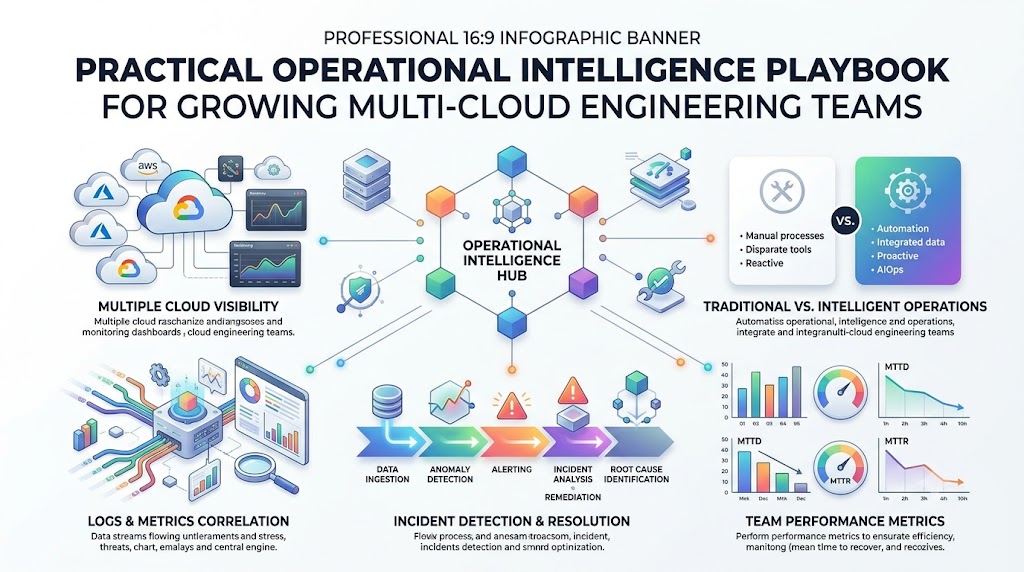
Modern enterprise networks generate massive volumes of telemetry that overwhelm day-to-day operations teams. Artificial Intelligence for IT Operations meets this crisis by tracking computing infrastructure automatically. Complex servers create endless logs and performance numbers every second of every day. People cannot read these rapid data streams quickly during urgent production breakdowns. Therefore, smart software engines continuously inspect the information flow to detect problems early. This handbook covers the fundamentals of modern operational platforms and automated workflows. You will discover practical ways to resolve software incidents and keep cloud services running smoothly.
What Is AIOps?
AIOps uses analytical software to help engineering teams resolve difficult infrastructure challenges. Artificial intelligence allows computer programs to evaluate technical issues like an experienced engineer. Machine learning enables these programs to recognize behavioral trends from historical system records. Operational teams rely on monitoring tools to watch networks, hard disks, and business applications. Connected devices constantly report metrics, which are numeric measurements like CPU speed or temperature. Machines also generate logs, which are written diary entries about system actions. Whenever an unexpected event occurs, systems store a new diary entry about that moment. Next, the tool applies alert analysis to organize thousands of buzzing warning notifications. It merges duplicate notices so operators see only critical system trouble. Then, root-cause analysis pinpoints the exact component that caused the whole disruption. Finally, automation triggers predefined scripts to heal simple failures without human labor.
Why Do IT Teams Need AIOps?
Modern businesses run complex networks across distributed multi-cloud systems. These huge setups trigger too many alerts during a single work shift. Operators experience alert fatigue because sirens ring without interruption. Engineers waste valuable time sorting through repeated incidents that offer no new information. Meanwhile, manual diagnostics delay repairs and extend annoying customer downtime. A tiny configuration error can hide inside millions of diary records. Smart algorithmic tools scan these massive information pipelines within seconds. They identify irregular data patterns early and direct specialists straight to the core malfunction. Even so, smart programs cannot fix every operational disaster on earth. Real people must still design recovery roadmaps and verify structural changes. The program merely clears the clutter so engineers can solve issues quickly.
AIOps Tasks and Benefits
Smart platforms carry out several primary operational jobs to simplify daily maintenance work:
- Log Reading means inspecting computer diary files, which uncovers hidden software bugs much faster.
- Noise Reduction means silencing duplicate warning sirens, which keeps engineers calm and productive.
- Anomaly Catching means tracking weird data spikes, which alerts specialists before outages crash live systems.
- Event Linking means tying related warnings together, which reveals the true primary service failure.
- Root Cause Search means detecting the initial broken part, which cuts out hours of manual guessing.
- Self-Healing means executing safe system repairs, which corrects minor software errors instantly.
What Does TheAIOps.com Offer?
TheAIOps.com shares structured educational materials regarding Artificial Intelligence for IT Operations. Students can explore practical AIOps Training to master data pipelines and system metrics. The portal also features an in-depth AIOps Course covering architecture designs and incident response methods. When you want to confirm your knowledge, you can study for an AIOps Certification. Companies can explore articles about each commercial AIOps Platform to choose great software. The website additionally shares insights on AIOps Consulting and practical AIOps Services. Such guidance helps businesses evaluate tool setups and adopt automated routines safely. An aspiring AIOps Engineer can use these open materials to sharpen daily technical skills.
AIOps Training and AIOps Course
An effective AIOps Course guides students through real computer environments step by step. First, pupils examine core fundamentals to understand how algorithmic systems manage corporate networks. Next, classes cover data collection, showing students how to gather metrics, traces, and diary entries. Learners then explore alert management to convert messy notification storms into clear diagnostic clues. Anomaly detection training teaches you how to identify strange surges in server memory usage. Students also practice root-cause analysis to follow an outage back to an unhealthy script update. Finally, learners write automation playbooks to reboot frozen services safely. Practical laboratory work provides the most value because production environments fail in unusual ways. Theoretical reading helps, but fixing broken test servers builds genuine confidence.
AIOps Learning Areas
Engineers preparing for operational roles must develop competence across multiple hands-on areas:
- Data Ingestion focuses on streaming logs, traces, and performance figures into one central repository.
- Noise Filtering focuses on condensing repetitive warning alarms into a single actionable incident ticket.
- Pattern Matching focuses on spotting historical outages that look identical to active system issues.
- Smart Alerting focuses on triggering notifications only when customer transactions face real danger.
- Root Analysis focuses on scanning software dependency trees to isolate the earliest failure point.
- Auto-Fix Rules focus on authoring safe automation scripts that restart crashed microservice instances.
- Model Tracking focuses on auditing algorithmic behavior so diagnostic recommendations remain accurate over time.
- Team Dashboards focus on assembling clear charts that communicate overall operational health to technical staff.
AIOps Certification and AIOps Engineer Skills
An AIOps Certification validates your grasp of data frameworks, system metrics, and smart automation rules. It demonstrates to prospective employers that you understand modern production support. Still, passing an exam will not turn you into a seasoned expert overnight. Every proficient AIOps Engineer requires sharp monitoring knowledge and disciplined diagnostic habits. You must interpret graphs swiftly and trace unexpected application delays. Furthermore, writing clean scripts allows you to automate repetitive recovery chores. You also need an understanding of statistics to see how predictive programs spot deviations. Strong verbal skills matter just as much because you must clarify system defects to teammates. Completing hands-on projects prepares you far better than memorizing multiple-choice questions.
AIOps Tools and AIOps Platform
An enterprise AIOps Platform gathers diverse data feeds into a unified operations center. It unifies monitoring tools that audit hardware components and observability tools that trace application requests. It also integrates log tools that archive event records and incident tools that notify duty engineers. Machine learning engines then process this pooled data across real-time timelines. However, organizations must evaluate their choices thoroughly before purchasing enterprise software licenses. First, outline your core operational headaches and business objectives clearly. Confirm whether the tool integrates smoothly with your current cloud providers. In addition, review subscription fees, compliance safeguards, and your team's existing technical capabilities. The right solution must handle growing traffic volumes as your enterprise launches additional applications.
AIOps Implementation: How Does It Work?
Leadership should launch an AIOps Implementation by targeting a single troublesome service. Never try to overhaul your entire technical footprint overnight. Begin by gathering clean performance data from the application that triggers the most incident calls. Feed those records into the analytics engine so it can observe operational trends. Next, configure strict filtering criteria to suppress harmless notification spikes. Activate anomaly detection algorithms so the platform learns standard traffic rhythms over time. Then, observe how the tool connects related warnings during high-traffic windows. After validating analytical accuracy, initiate simple automated tasks like purging temporary memory caches. Preserve manual approval gates for high-stakes actions like altering database tables. Evaluate operational gains monthly, refine alert definitions, and roll out the system across other teams gradually.
AIOps Consulting and AIOps Services
Enterprises often lean on AIOps Consulting to accelerate their operational modernization programs. Professional AIOps Services help companies review infrastructure health, software tools, and internal team habits. These consultants recommend fitting platforms and map out a sustainable adoption schedule. They also guide staff through configuring cross-cloud connections and authoring custom operational rules. Additionally, third-party mentors train in-house engineers to interpret predictive machine learning charts correctly. Even so, internal managers must articulate precise business targets before retaining outside agencies. Decide whether you want fewer nocturnal escalations, faster recovery cycles, or lower infrastructure expenses. Clear expectations ensure that your organization extracts measurable returns from consulting investments.
Real-Life Scenarios / Experiences
- A digital marketplace encountered checkout errors during a massive flash sale. The analytical system bundled six hundred active sirens into one concise report. It showed that an authentication service had consumed all available network ports. The on-call team repaired that specific container within two minutes.
- A payment provider faced nuisance alarms during scheduled database reorganizations every Sunday night. The smart platform recognized the periodic maintenance routine across several weeks. It muted those safe, predictable load spikes so engineers enjoyed peaceful sleep.
- A media streaming company pushed an update that caused background audio services to fail. The automated monitoring system detected the sudden drop in active user sessions immediately. It reverted the deployment script safely before customers started submitting complaint tickets.
How TheAIOps.com Can Help
TheAIOps.com curates vendor-neutral educational guides for practicing engineers and engineering leaders. The website breaks down advanced machine learning concepts into approachable learning units. Readers can compare leading commercial tools without dealing with promotional sales pressure. Beginners can review structured career roadmaps and essential troubleshooting practices. Furthermore, companies can discover impartial advice on service planning and tool implementations. This educational repository equips you with practical knowledge for ongoing professional growth.
A Practical Implementation Approach
Focus your initial rollout on a single brittle application that frequently causes headaches for on-call personnel. Extract clean performance metrics and diagnostic traces from that target system. Stream those data points directly into your analytics pipeline. Next, craft baseline policies that weed out temporary network stutters and redundant notifications. Allow the statistical engine to monitor normal operating patterns for several weeks. Validate suspicious alerts against real system behavior to ensure the tool behaves reliably. Afterward, create basic automated routines to tackle low-risk operational cleanups. Require an engineer to authorize sensitive adjustments that could impact live user records. Track recovery timeframes closely to verify whether operational numbers improve over time. Once the group builds solid trust in the tooling, onboard additional services gradually.
Common Mistakes to Avoid
- Automating sensitive infrastructure changes without establishing manual safeguard checks.
- Ingesting messy, corrupted, or fragmented log feeds into the algorithmic platform.
- Expanding the software across the entire enterprise before scoring a single small victory.
- Purchasing an expensive enterprise tool without identifying clear operational needs first.
- Neglecting internal team development by skipping essential technical training courses.
- Assuming algorithmic software will repair sloppy, defective application code.
- Relying on default alert thresholds, which floods inboxes with pointless notification clutter.
- Failing to update statistical models when developers launch major software modifications.
Frequently Asked Questions
1. What does AIOps mean in simple terms?
Smart software scans operating networks to keep computer environments healthy. The program collects telemetry from applications, bare servers, and cloud resources continuously. It suppresses harmless warning noise and flags genuine software defects. Then, the tool guides engineers toward the exact equipment that needs attention.
2. Can AIOps replace human IT workers?
Real human engineers retain their jobs because software merely assists their daily work. The program handles repetitive tasks like filtering duplicate warning messages. Humans continue making vital architectural decisions, fixing complicated software logic, and securing sensitive data. The analytical tool acts like an attentive assistant.
3. How does machine learning help IT teams?
Historical operational data teaches algorithms to recognize normal baseline behavior. When server statistics jump or fall unexpectedly, the model detects the variation instantly. It flags these deviations as anomalies before regular computer users suffer sluggish response times.
4. What is the difference between monitoring and AIOps?
Traditional monitoring tools merely ring an alarm whenever a server threshold breaks. That older approach often unleashes hundreds of conflicting sirens for a single root failure. Intelligent operations platforms ingest all those alerts together. They correlate related signals and expose the true underlying snag.
5. Do small companies need smart operations tools?
Early-stage startups running a couple of simple servers do not require complex operational software. Basic open-source monitors handle simple workloads adequately. However, when an enterprise scales into hundreds of interconnected cloud instances, algorithmic platforms become necessary to manage the heavy data deluge.
6. What skills does an AIOps Engineer need most?
Candidates need solid foundations in operating systems and cloud monitoring concepts. You must know how to inspect system diaries and follow network traces. Basic scripting abilities allow you to code dependable recovery automations. Strong communication skills also help you explain complex defects to colleagues.
7. Why do implementations sometimes fail?
Overly ambitious teams frequently fail because they try to connect too many services at once. Other organizations feed incomplete, inaccurate telemetry into their fresh platforms. Incomplete data leads to mistaken algorithmic conclusions. Teams must start modestly, cleanse incoming data, and train staff thoroughly.
8. What is alert noise in computer systems?
Failing infrastructure often fires thousands of repetitive warning messages into engineer inboxes. Most of these frantic alarms stem from one shared hardware glitch. Staff members grow exhausted and miss genuine emergencies. Smart platforms suppress duplicate notices so staff can focus on critical work.
9. How does root-cause analysis work?
The software follows data dependencies across servers, applications, and networks during an incident. It identifies which digital asset malfunctioned first along the timeline. Instead of investigating dozens of machines, specialists inspect the primary culprit immediately. This focused tracing saves hours of investigation.
10. Is an expensive platform always required?
Enterprises do not always need to purchase costly software packages immediately. Many engineering groups connect accessible tools to analyze system logs effectively. You should consider a commercial suite only when your infrastructure expands beyond basic capabilities and demands advanced event correlation.
11. How does automation help IT operations?
Pre-built code routines execute vital recovery steps without requiring a person to type commands manually. For instance, scripts can reboot a crashed service in two seconds. They can also delete bloated cache folders automatically. This immediate response preserves uptime during peak holiday shopping traffic.
12. Where can beginners learn about smart operations?
Aspiring specialists can read open technical guides, review product documentation, and construct test home labs. Portals like TheAIOps.com provide helpful learning paths, software overviews, and certification advice. Working with test logs and monitoring setups builds dependable skills for modern engineering careers.
Conclusion
Enterprises depend on distributed cloud architectures that become more intricate with every software release. Modern tech workers need dependable tools to filter warning sirens and catch critical service disruptions early. Mastering data ingestion, root-cause diagnostics, and safe automation helps you maintain resilient digital platforms. Never attempt to automate your entire application stack at once. Begin with a single problematic service, verify your system telemetry, and test recovery scripts carefully. Platforms like TheAIOps.com offer valuable educational materials for your learning path. With consistent effort, clean data practices, and hands-on experimentation, any dedicated engineer can thrive in modern IT operations