Useful Guide for Evaluating Experienced Fertility Clinics and Real Treatment Cycle Budgets
Introduction
Starting a family through fertility care often brings up dozens of tough questions. Many couples feel swamped when they look at different medical providers and price lists. Clinic prices shift quickly, and success statistics confuse even smart adults. Also, deciding whether to stay local or fly across borders creates real stress. You need straightforward information before you spend your hard-earned savings. Simple facts make this entire medical path feel less scary. A neutral platform like IVFHospitalsNow.com supports your learning process right from home. It gives clear details about care providers, tests, and actual expenses without tricky sales pitches. That way, you gain the confidence to talk with your fertility doctor. Taking time to learn protects your health and your wallet.
WHat is IVFHospitalsNow.com
IVFHospitalsNow.com serves as an independent learning hub and directory for fertility patients. It does not treat patients, prescribe drugs, or run clinics. Instead, the platform collects objective facts about doctors, diagnostic tests, and care plans. Readers use the site to discover fertility clinics across different cities and nations. It lays out clear price patterns so you can budget without fear. You can also read simple guides on medical procedures and success statistics. The site helps you build a smart question list for your doctor appointments. It works like an open library for anyone planning a future family.
Start by Learning About IVF Clinics
Fertility clinics operate as specialized medical centers that help hopeful parents conceive. Physicians, nurses, and embryologists work side by side in these facilities. They run comprehensive diagnostic checks on both partners to pinpoint health hurdles. These centers perform in vitro fertilization, which most people simply call IVF. In this process, scientists combine an egg and sperm inside a specialized laboratory dish. Clinics also perform ICSI, which places an individual sperm inside an egg cell. Some patients choose IUI, which sends cleaned sperm straight into the uterus. Other people freeze eggs so they can build a family during later years. Clinics also provide hormone pills, daily shots, and ultrasound imaging. Because every facility uses different tools, staff, and pricing plans, you should review multiple providers before booking care.
What Should You Check Before Choosing?
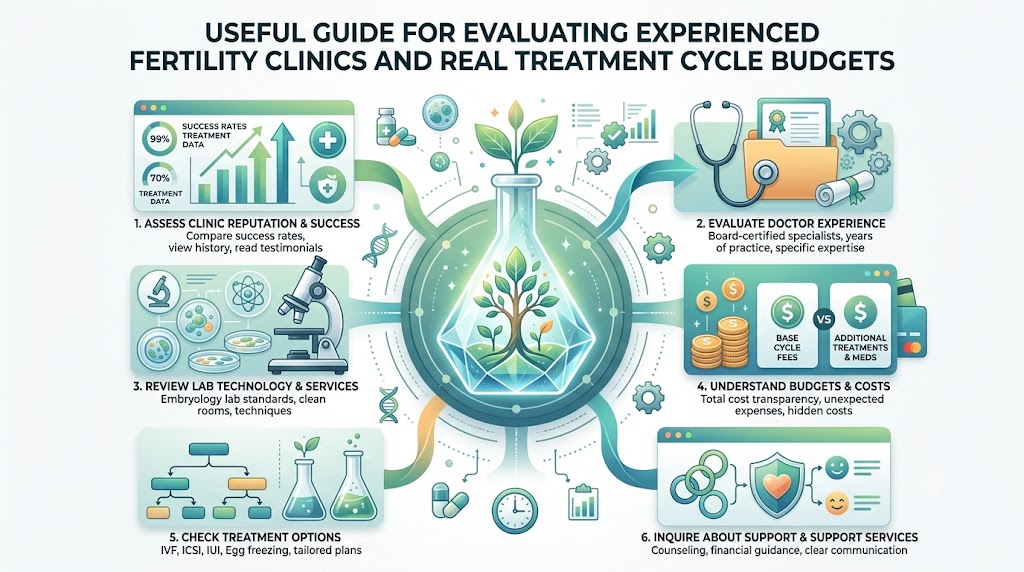
Smart patients check eight core factors before picking a fertility center. Reviewing these points gives you a complete view of your upcoming treatment:
- Treatment options: This factor shows the exact medical services and procedures the clinic provides.
- Doctor experience: This factor helps you understand the background, skill, and training of your care team.
- Lab services: This factor supports high-quality IVF care and protects developing embryos during culture.
- Full cost: This factor helps you avoid unexpected bills by showing all required medical fees upfront.
- Success data: This factor gives useful context about patient outcomes across different age groups.
- Patient support: This factor helps you handle emotional stress with counseling and dedicated nurse care.
- Location: This factor affects your daily commute, transit fatigue, and overall physical comfort.
- Eligibility rules: This factor confirms patient requirements regarding age, relationship status, and health limits.
Understanding IVF Treatment Cost
The total IVF treatment cost varies because each medical case demands unique care. Standard base rates cover doctor consultations, egg retrieval procedures, and initial lab support. But almost every patient needs extra services that boost the total bill. Prescription hormone shots stimulate the ovaries, and specialty pharmacies charge separate fees for these drugs. Patients also pay for routine blood draws, ultrasound checks, and specialized lab procedures. When patients create surplus embryos, clinics charge freezing fees and recurring annual storage fees. Many individuals also require multiple treatment cycles before they achieve a healthy pregnancy. Because basic clinic quotes leave out these add-ons, you must request an itemized fee sheet in writing.
What to Check Before Choosing an IVF Clinic
Selecting the right clinic requires you to inspect several vital areas of care. Reviewing these elements protects your safety and financial plan:
- Treatment options: This factor outlines the full range of medical choices the clinic offers.
- Doctor experience: This factor helps you evaluate the expertise and track record of your physicians.
- Lab services: This factor ensures advanced laboratory equipment supports your egg and embryo growth.
- Full cost: This factor protects your budget by revealing hidden charges before you sign agreements.
- Success data: This factor provides meaningful insight into live birth outcomes for your age bracket.
- Patient support: This factor guides you through difficult treatment stages with personalized care and counseling.
IVF Cost Comparison Table
Fertility prices fluctuate between medical centers, domestic cities, and foreign territories. Personal physical traits and medical conditions also change your final bill. Review these essential questions with clinic financial coordinators before starting any treatment cycle:
- IVF cycle: Ask the clinic staff what medical procedures the primary package fee actually covers.
- Medicine: Ask the clinic team if the quote includes daily ovarian stimulation medications.
- Testing: Ask the financial staff whether pre-cycle blood draws and monitoring scans are included.
- Egg collection: Ask the surgical team if the retrieval procedure and anesthesia fees are part of the base price.
- Lab work: Ask the embryology staff if standard laboratory services and fertilization tools are included.
- Embryo transfer: Ask the clinical team if the embryo transfer procedure carries an extra charge.
- Freezing: Ask the laboratory technicians if the initial embryo or egg freezing process is included.
- Storage: Ask the billing department to state the ongoing annual storage fee for frozen samples.
How to Read IVF Success Rates
Prospective parents naturally look at clinic scorecards, but statistics demand careful review. A single clinic percentage cannot tell you how your own body will respond. A woman's age heavily influences egg quality and overall embryo strength. Your underlying medical diagnosis also impacts how well your body accepts fertility medication. High success numbers often come from young patients or donor egg programs. Furthermore, you must verify whether a clinic reports positive chemical tests or actual live baby deliveries. A take-home baby remains the real goal of fertility care. Some facilities combine data from multiple attempts to make their numbers look better. Always ask the clinical team what their published numbers truly represent.
IVF Clinics Near Me or IVF Treatment Abroad?
You can seek care at neighborhood clinics or travel across international borders. Searching for IVF clinics near me lets you recover in your own home after procedures. Local medical centers lower travel stress and simplify morning blood draws. You maintain your daily work schedule and stay close to trusted friends. Still, some individuals look into IVF treatment abroad to reduce direct medical bills. When you review IVF cost by country, you must look far beyond basic doctor charges. You must add the expense of plane tickets, hotel stays, ground transit, and daily meals. In addition, other nations follow different legal rules regarding egg donors, sperm banks, and marital status. Language barriers and overseas flights also introduce physical fatigue. Weigh every financial and emotional factor before booking an international flight.
Real-Life Scenarios / Experiences
- Choosing Convenience at Home: An accountant picked a clinic ten minutes from her office. She attended early morning monitoring visits before work, which saved her vacation days and eliminated hotel expenses.
- Pursuing Cross-Border Medical Care: A couple flew to Spain because local laws in their home state restricted specific donor treatments. They rented an apartment for twenty days, which increased their initial travel budget.
- Encountering Unexpected Pharmacy Bills: First-time patients signed a contract for an affordable cycle package. They felt shock when the specialty pharmacy billed thousands of dollars for daily hormone injections.
- Managing Long-Term Storage: A couple produced six healthy blastocysts during their initial egg retrieval. They transferred a single embryo and now budget recurring fees each year to protect the remaining five frozen embryos.
ICSI vs IVF
Standard IVF and ICSI represent two distinct laboratory methods for fertilizing eggs. During conventional IVF, an embryologist places an egg into a dish with thousands of moving sperm. The most energetic sperm cell penetrates the outer egg layer without human intervention. In ICSI, an embryologist uses a microscopic glass needle to place a single selected sperm into an egg. Medical teams recommend ICSI when a male partner produces low sperm counts or poor motility. Neither technique fits every medical scenario. ICSI adds extra expense because it requires fine manual micro-manipulation. Always ask your fertility doctor why they prefer one method over the other for your cycle.
Fertility Treatment Options
In vitro fertilization represents only one branch of modern reproductive medicine. Many doctors first prescribe simple oral tablets or injections to stimulate regular ovulation. Another common first step is IUI, which delivers prepared sperm straight into the uterus. When less invasive options fail, doctors recommend IVF or advanced ICSI procedures. Individuals who wish to delay parenting until later years often pick egg freezing. Before recommending any therapy, physicians perform blood panels and pelvic ultrasounds. These diagnostic tests pinpoint the root causes of reproductive delays. Your medical provider designs an individual plan that addresses your body's exact needs.
Egg Freezing Cost
Egg freezing allows an individual to preserve healthy reproductive cells for later years. You administer daily hormone injections to help several follicles mature simultaneously. Next, a fertility specialist retrieves these mature eggs during an outpatient procedure. Embryologists freeze the collected eggs in liquid nitrogen tanks for long-term safety. The overall egg freezing cost includes pre-cycle blood work, monitoring visits, and pelvic scans. You must also pay the pharmacy for stimulation medications and pay the surgery center for retrieval. Clinics bill additional fees for the vitrification freezing process itself. After retrieval, you must pay annual rent fees to keep the cells frozen. Initial promotional packages rarely cover the future costs of thawing, fertilizing, and transferring embryos.
Common Mistakes to Avoid When Choosing Delhi Events
- Focusing Only on Low Prices: Bargain medical packages often hide expensive add-on fees for basic lab work. Demand an all-inclusive price breakdown before signing any clinic contract.
- Trusting Generic Success Claims: High overall percentages might reflect only twenty-year-old patients. Request success data that matches your specific age and medical condition.
- Overlooking Lab Certifications: A poorly maintained laboratory lowers embryo survival rates. Check the clinic's embryology equipment and scientist credentials.
- Underestimating Commute Fatigue: Driving long hours for alternating morning scans drains your energy. Select a facility that fits smoothly into your weekly routine.
- Leaving Out Medication Budgets: Clinic quotes rarely include costly ovarian stimulation drugs. Ask your clinical team for an honest medication estimate.
- Accepting Rotating Doctors: Certain high-volume centers pass patients between different doctors each visit. Insist on a dedicated primary doctor who tracks your treatment plan.
- Ignoring Annual Storage Invoices: Preserving surplus embryos generates ongoing annual rental charges. Learn the exact yearly maintenance fees for frozen samples.
- Planning for Only One Round: Many women require several retrieval attempts to secure enough healthy eggs. Budget enough funds for a second cycle if needed.
Simple IVF Clinic Comparison Plan
- Pick three to five licensed fertility centers in your target area.
- Draft an identical list of questions for each consultation.
- Compare the specific diagnostic tools and clinical treatments each facility provides.
- Review total itemized cost estimates, including drugs and storage.
- Study validated birth statistics for patients in your age bracket.
- Assess local travel routes, public transit, or required hotel stays.
- Ask about dedicated nurse lines and emotional support groups.
- Review your gathered findings with a qualified medical specialist.
IVF Cost Areas to Check
Comparing financial quotes requires you to verify every single billable line item. Always ask clinic managers these key questions to avoid unexpected charges:
- IVF cycle: Ask what basic doctor and facility services are included in the primary cycle charge.
- Medicine: Ask if the provided estimate includes all injectable hormone prescriptions and pharmacy support.
- Testing: Ask if ongoing hormonal blood panels and diagnostic ultrasound checks are included in the price.
- Egg collection: Ask if operating room fees, surgical retrieval tools, and physician charges are covered.
- Lab work: Ask if standard embryology care, culture media, and egg dish prep are covered.
- Embryo transfer: Ask if ultrasound guidance and catheter placement for embryo transfer carry separate costs.
- Freezing: Ask what the laboratory charges to freeze extra viable embryos or unfertilized eggs.
- Storage: Ask for the exact annual billing rate to store your frozen reproductive cells securely.
Role of IVFHospitalsNow.com
IVFHospitalsNow.com simplifies your medical research by organizing fertility facts into clear guides. The platform explains complex laboratory treatments and testing steps without medical jargon. You can explore regional clinics and overseas destinations without facing sales pressure. It outlines typical medical fees so you can plan realistic household budgets. The site breaks down dense clinic statistics into easy concepts. You can also review foreign regulatory frameworks if you decide to travel abroad. Keep in mind that the platform operates as an educational library rather than a clinic. It gives you objective facts so you can ask smart questions during doctor visits.
Frequently Asked Questions
1. What is an IVF clinic?
A fertility center provides specialized medical care to help patients conceive children. Doctors and scientists evaluate reproductive organs, run hormone panels, and check sperm quality. They offer treatments such as ovulation medication, IUI, and complete IVF cycles. These centers house advanced laboratories that fertilize eggs and culture growing embryos.
2. How much does IVF treatment cost?
Total treatment expenses change depending on your clinic and treatment protocol. A single round includes doctor consultations, egg retrieval, and laboratory procedures. However, patients must also buy separate stimulation drugs and pay for ultrasound scans. Freezing extra embryos also adds annual fees. Always obtain an itemized financial quote in writing.
3. How do I read IVF success rates?
Success statistics report how frequently specific procedures produce pregnancies or live births. But high clinic averages never guarantee that your own cycle will work. Outcomes depend heavily on female age, underlying diagnosis, and egg quality. Look closely to see whether data points mean positive tests or actual live births.
4. How can I compare IVF clinics?
Begin by reviewing physician credentials, laboratory tools, and total treatment fees. Find out which advanced procedures the laboratory performs on site. Ask about patient support services and nurse contact availability during weekends. Look at daily travel requirements as well. Interview three separate clinics using identical questions to evaluate their care.
5. Should I search for IVF clinics near me?
Staying close to home eliminates stressful road trips and airport visits. An IVF cycle requires numerous morning appointments for blood checks and ovarian ultrasounds. Local treatment allows you to sleep in your own bed and keep working. You also enjoy immediate support from nearby relatives and friends.
6. Why do people choose IVF treatment abroad?
Patients frequently travel internationally to find lower medical prices. Others seek cross-border treatment because foreign laws permit donor choices that their home countries ban. For instance, specific destinations offer flexible rules for single parents or donor matching. However, international care demands travel budgets, hotel stays, and careful planning.
7. How does IVF cost by country differ?
Treatment fees shift across borders due to local wages, government policies, and living costs. While foreign clinics offer lower base prices, your flight and hotel expenses increase the total outlay. Overseas clinics might also bill foreign visitors higher rates than domestic residents. Calculate every travel expense before you schedule care abroad.
8. What are my fertility treatment options?
Medical science provides several options beyond standard IVF procedures. Many patients begin with simple hormone tablets that help the ovaries release eggs. Others pick IUI, which deposits prepared sperm into the uterus at ovulation. Doctors also use ICSI or egg freezing when specific needs arise. A board-certified doctor helps you select the best path.
9. What is the difference between ICSI and IVF?
Standard IVF places an egg into a petri dish with thousands of motile sperm. The strongest sperm fertilizes the egg naturally. During an ICSI cycle, an embryologist manually injects one selected sperm into an egg. Doctors utilize ICSI when semen analysis shows low sperm counts or poor shape.
10. What is included in egg freezing cost?
Initial egg freezing fees cover doctor appointments, ovarian stimulation drugs, and egg retrieval surgery. The clinic laboratory bills separate fees to vitrify the collected cells. Patients then pay recurring yearly rent to store the frozen eggs safely. Initial fees do not cover future thawing, sperm fertilization, or embryo transfers.
11. Does one IVF cycle always work?
A single IVF cycle does not guarantee a successful delivery for every patient. Many individuals need two, three, or more cycles to build their family. Maternal age and underlying health problems directly influence every attempt. Specialists frequently alter drug protocols after an initial try to improve results.
12. How does IVFHospitalsNow.com help my research?
The platform shares objective educational materials on reproductive medicine and clinics worldwide. It never sells medical procedures, advertises specific doctors, or ranks clinics. It translates complicated procedures, treatment fees, and clinical statistics into clear reading. You can use its guides to prepare intelligent questions for your upcoming medical consultations.
Conclusion
Researching fertility care demands calm patience, realistic expectations, and clear facts. Take time to evaluate clinic reputations, full expense sheets, lab equipment, and doctor backgrounds. Look past general clinic marketing and study success statistics that match your age group. Independent websites like IVFHospitalsNow.com offer neutral guidance so you can study your options without sales pressure. Bring your notes, questions, and personal goals to a licensed fertility specialist to map out your care.