Essential Site Reliability Engineering Concepts Every Software Team Needs for System Uptime
Introduction
People expect online stores, video apps, and games to load fast without errors. When an app breaks, users feel sad and leave right away. Site Reliability Engineering keeps these big computer systems working without unexpected stops. It blends writing software code with daily operations tasks to protect important systems. Engineers fix weak spots early so platforms stay fast and safe. SRESchool.com serves as a dedicated platform for learning practical skills and accessing professional services. Anyone can explore these clear methods to make websites much stronger today.
What Is Site Reliability Engineering?
Site Reliability Engineering means using software programs to protect systems from breaking. Think of a toy train track that never lets trains fall off. SRE teams watch computers day and night to keep websites healthy. They write smart code to fix common glitches before people notice them. Reliability simply means that a service works properly every single time you click. Teams measure system health, track performance, and automate boring daily tasks. They also learn valuable lessons from every small crash to prevent repeat troubles.
Why Site Reliability Engineering Matters
Modern life relies heavily on websites, cloud systems, and connected computer networks. A tiny glitch in one server can knock out shopping carts for millions. SRE helps engineers spot warning signs before an entire platform shuts down completely. Teams solve hidden troubles quickly so businesses do not lose happy customers. Fast repairs also protect valuable company data from sudden damage during peak hours. Good engineering teams make reliability a natural part of their daily work habits. This constant care keeps big web applications running smoothly under heavy user traffic.
What Does an SRE Team Do?
A reliable team handles many vital duties to keep apps online and safe. Engineers watch live server dashboards to catch performance drops before users complain. Smart alerts notify on-call staff immediately whenever an unusual error happens in production. The team jumps into action fast to restore broken services for active users. They build automatic scripts so computers fix basic repeating errors by themselves. They also plan future capacity so servers handle huge holiday shopping crowds easily. Afterwards, teams write postmortem reviews to discover real root causes and improve systems.
Key SRE Terms Made Easy
Reliability engineers use special words to talk about system health and daily work:
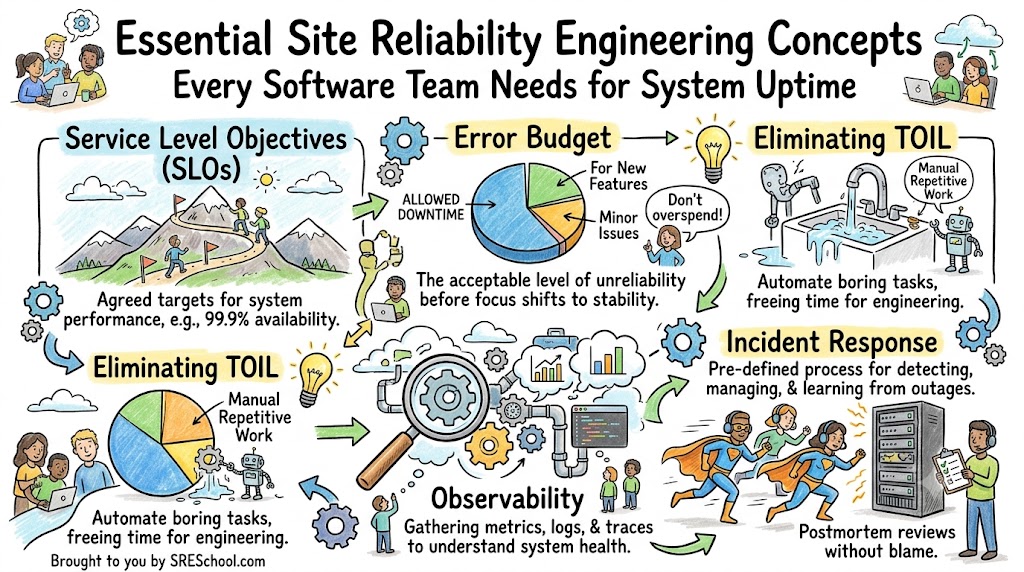
- SLI means a real measurement of service health, such as timing web page loading speeds in seconds.
- SLO means an agreed target goal for system success, like keeping web pages fast ninety-nine percent of days.
- Error Budget means the tiny amount of downtime a service allows safely, such as forty minutes each month.
- Toil means repetitive manual operational tasks, like resetting broken user account passwords by hand every single morning.
- Observability means seeing inside systems clearly by reading diagnostic logs to locate hidden software bugs quickly.
- On-call means being ready to fix emergencies, such as carrying an alert phone during busy weekend shifts.
- Incident means an active problem hurting users, like an online checkout page suddenly failing to process customer payments.
What Is SRE Training?
Beginners often take structured lessons to understand modern system reliability from scratch. Good classes teach core ideas like SLIs, SLOs, and helpful error budgets clearly. Students learn how to track system logs and build useful real-time health dashboards. They study incident management to coordinate quick fixes during sudden system outages. Lessons also show how to write automation code that removes boring manual toil. Learners discover cloud capacity planning to keep web apps online during huge rushes. SRESchool.com provides guided lessons so engineers build deep practical confidence through direct lab exercises.
What Is SRE Certification?
A professional certificate proves that an engineer understands key reliability concepts and practices. A Certified Site Reliability Engineer knows how to track health and manage unexpected outages. Structured exam paths guide students through core concepts step by step without confusion. However, a paper certificate alone cannot replace real hands-on practice with live software systems. Hiring managers always look for practical project experience alongside verified testing credentials. Engineers should build real code projects to prove their skills to future technology employers. Combining certificates with actual lab practice leads to true long-term career growth.
What Is a Site Reliability Engineering Course?
A complete course gives learners an organized roadmap for mastering complex computer systems. Students start with simple system basics before moving to advanced server monitoring techniques. Next, they set reliability goals, practice incident response, and write helpful automation programs. They also explore resilient cloud setups to prepare systems for massive user traffic. Clear hands-on exercises help both new beginners and experienced software engineers build strong confidence. Working through guided labs prepares technical minds for complex challenges in modern enterprise jobs. Step-by-step guidance turns scary system breakdowns into simple puzzles with easy answers.
SRE Tools Made Simple
Engineers use specialized software tools to inspect running systems and spot hidden problems:
- Monitoring and Metrics allows engineers to practice collecting live server health data using Prometheus background agents.
- Visual Dashboards allows engineers to practice building clean, colorful system charts with interactive Grafana panels.
- Distributed Tracing allows engineers to practice following user web requests across multiple microservices using OpenTelemetry.
- Operational Automation allows engineers to practice writing smart scripts to restart broken server containers automatically without human help.
- Incident Drills allows engineers to practice rapid team coordination during simulated high-stress production server outages.
Real-Life Scenarios in Practice
- A viral news post sends ten times more visitors to an online shop, but automated cloud scaling launches fresh servers in seconds to keep checkout pages fast.
- A bad software update causes payment errors, so the alert system detects the failure immediately and triggers an automated rollback to restore normal orders.
- Engineers spend two hours every Monday morning clearing old cache files by hand, so they write a quick script that deletes old files automatically every night.
- A primary database server loses network power suddenly, but the backup replica takes over active traffic instantly without dropping a single active customer session.
What Is SRE Consulting?
SRE Consulting brings experienced reliability specialists into an organization to improve messy systems. These external experts review daily operations to find hidden technical risks before disasters strike. They help engineering teams establish clear SLO targets and pick the right monitoring tools. Consultants also teach staff how to handle high-stress production incidents without panic. They show teams how to eliminate boring repetitive toil with clean automation code. With their guidance, companies build practical long-term improvement plans to raise overall system reliability. This expert help saves businesses money by preventing expensive and embarrassing platform outages.
What Is SRE as a Service?
Some growing companies need reliable computer platforms but lack their own internal engineers. SRE as a Service provides continuous remote engineering support for modern cloud setups. External specialists monitor critical servers, manage unexpected incidents, and review overall platform security daily. They optimize cloud spending, automate recurring maintenance tasks, and plan server capacity for growth. Companies should define their specific technical needs clearly before hiring an external support team. This managed approach gives smaller businesses enterprise-grade reliability without hiring full-time internal departments. It allows software teams to focus on building fun product features instead of server fixes.
What Is Corporate SRE Training?
Corporate training brings an entire company technology team together to build shared reliability habits. Instructors customize practical lessons around the exact cloud tools that the enterprise uses daily. Developers and operations engineers learn to talk the same language using SLOs and SLIs. They practice mock incident drills together to sharpen team communication during sudden system outages. Teams also build automation scripts to eliminate repetitive chores from their weekly schedules. Hands-on group workshops ensure that every engineer knows how to protect live production systems. Investing in team education prevents costly downtime and boosts developer morale across the organization.
Common Operational Mistakes to Avoid
- Setting system availability targets to one hundred percent creates impossible goals that burn out engineers.
- Creating too many noisy alert notifications causes alert fatigue, so engineers ignore real critical emergencies.
- Skipping automated scripts forces team members to waste precious hours on boring manual chores.
- Ignoring error budgets leads developers to release risky features that break live production websites.
- Blaming individual engineers for unexpected crashes damages team trust and hides the real systemic problems.
- Deploying large software updates all at once increases the danger of massive unrecoverable system outages.
- Forgetting to test emergency disaster recovery plans leaves teams unprepared for sudden real server crashes.
- Relying solely on basic server checks without distributed tracing makes deep software bugs completely invisible.
How SRESchool.com Can Help
SRESchool.com provides modern learning resources and professional services to help engineers master reliability. The platform offers structured SRE Training with practical hands-on labs for beginners and experienced professionals. Candidates can prepare for recognized SRE Certification programs to validate their skills and advance careers. Learners follow an extensive Site Reliability Engineering Course and explore detailed SRE Tutorial articles. The site also guides engineers on using industry-standard SRE Tools for real-time monitoring and automation. Organizations can access SRE Consulting, SRE as a Service, and Corporate SRE Training to strengthen enterprise platforms.
Frequently Asked Questions
1. What does Site Reliability Engineering mean in simple terms?
Site Reliability Engineering uses software engineering techniques to solve complex operational problems on live servers. It treats system operations as a software challenge rather than a manual chore. Engineers write smart code to automate server repairs and monitor application health continuously. This balanced discipline keeps modern websites, online stores, and mobile applications fast, safe, and dependable for everyday users worldwide.
2. Can beginners learn Site Reliability Engineering without prior experience?
Yes, motivated beginners can learn this field by studying fundamental computer concepts step by step. You should start by understanding basic operating systems, computer networking, and simple coding with Python or Go. Next, explore how cloud servers host websites and how monitoring tools collect health data. Practical labs and structured tutorials help newcomers build solid operational skills quickly.
3. What is the difference between DevOps and SRE?
DevOps represents a broad organizational culture focused on breaking down silos between developers and operations teams. Site Reliability Engineering provides concrete practices, specific metrics, and clear engineering rules to implement that vision. While DevOps describes what teams want to achieve, SRE outlines exact daily instructions for keeping software stable, measurable, and reliable in real production environments.
4. What is a Service Level Objective?
A Service Level Objective serves as an agreed target goal for the reliability of a software service. For instance, a team might decide that an online store must work successfully ninety-nine percent of the time. This clear target helps engineers balance fast feature releases against steady system stability so that users remain satisfied every single day.
5. Why are Error Budgets useful for engineering teams?
An Error Budget represents the tiny amount of downtime a software service can experience safely. It creates an objective measurement that stops arguments between creative developers and cautious operations teams. If a system stays within budget, developers can release new features rapidly. If the budget runs out, everyone pauses new releases to fix underlying reliability bugs.
6. What tools should a new reliability engineer learn first?
Beginners should start by learning Prometheus to collect system metrics and Grafana to build visual dashboards. Next, explore OpenTelemetry to understand how data requests travel across complex distributed microservices. Finally, learn basic automation tools like Ansible or Terraform to manage cloud infrastructure with clean code. Mastering these core tools helps engineers inspect and protect live production systems effectively.
7. Does earning a certificate guarantee a great engineering job?
A certificate proves that you studied fundamental concepts, but it does not guarantee immediate employment. Technology companies look for practical problem-solving skills and hands-on project experience with real software platforms. You should combine certification studies with personal home labs, code repositories, and real incident troubleshooting practice. Practical experience always carries significant weight during technical job interviews.
8. What is operational toil in everyday engineering?
Toil refers to repetitive, manual tasks that provide little enduring value and grow as systems scale up. Examples include resetting user accounts manually, restarting crashed servers by hand, or generating routine reports weekly. Reliability engineers actively write software scripts to automate these chores away. Eliminating toil frees valuable time for creative software improvements and system resilience design.
9. When should a growing business consider external consulting?
A business should consider outside consulting when frequent outages hurt revenue or engineering teams feel overwhelmed by daily maintenance. Expert advisors can review technical architectures, uncover hidden operational bottlenecks, and design clear reliability strategies. They guide staff on setting sensible SLO targets and improving incident response. Outside expertise accelerates platform improvements without costly hiring delays.
10. How does SRE as a Service help smaller startups?
Early-stage startups often cannot afford to hire an entire internal team of specialized reliability engineers. SRE as a Service gives them direct access to experienced platform professionals on an ongoing, shared basis. These external specialists manage monitoring dashboards, secure cloud resources, and handle emergency outages. This support allows internal startup engineers to focus purely on building attractive customer features.
11. What happens during a typical postmortem review?
During a postmortem meeting, the engineering team discusses a recent production outage in a blameless, honest atmosphere. They investigate the root causes that triggered the failure and outline the timeline of the fix. The team then assigns specific action items to prevent the identical problem from happening again. Writing constructive postmortems helps technical teams learn and improve continuously.
12. Why is blameless culture essential for reliability teams?
A blameless culture encourages engineers to speak openly about mistakes without fear of personal punishment or shame. System crashes usually stem from flawed processes, poor tooling, or confusing software interfaces rather than bad workers. When teams focus on fixing weak systems instead of blaming people, they discover real causes faster. Open communication creates a safe environment that builds stronger, more resilient platforms.
Conclusion
Site Reliability Engineering combines software programming and daily operations to keep digital platforms running without unexpected stops. Teams track system health, eliminate repetitive manual tasks with automation, and learn valuable lessons from every small outage. Beginners can learn these concepts through structured courses and interactive tutorials, while organizations can use professional consulting and managed services to protect their cloud platforms. Platforms like SRESchool.com offer comprehensive training programs, professional certifications, and enterprise services that guide learners and companies toward modern engineering excellence. Mastering these practical habits ensures that websites and mobile applications stay fast, safe, and dependable for users everywhere.