Modern Enterprise Data Operations Frameworks For Streamlined Automated Reporting Systems Worldwide
Introduction
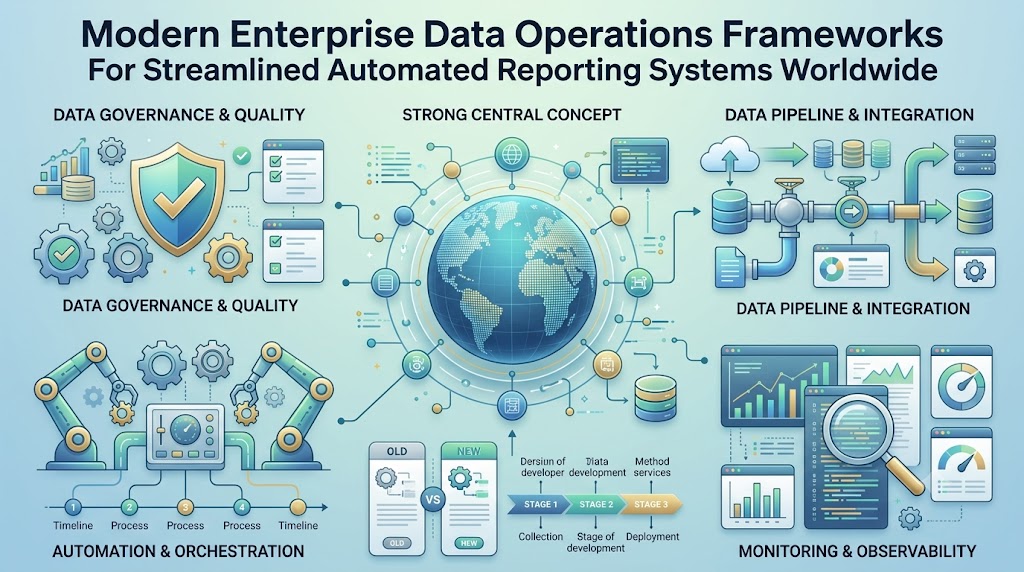
Healthy businesses rely on accurate records to guide their everyday choices. Faulty figures mislead managers, waste valuable hours, and hurt company income. Fragmented workflows cause endless delays, broken jobs, and deep frustration across technical teams. Within this practical overview, we study direct methods to fix unreliable files and slow handoffs. We review automated jobs, daily validations, essential competencies, and robust monitoring setups. We also highlight how learning hubs like TheDataOps.org deliver structured guides for builders. Smooth team habits connect workers so information travels rapidly without painful surprises or broken charts.
What Is DataOps?
Picture a city water network that brings crisp water right to your faucet. Clean streams leave the reservoir, pass through filters, and reach your home safely. Similarly, operational records travel from customer apps straight into secure analytical databases. DataOps unites smart workers, daily testing routines, and specialized programs to safeguard these channels. It adopts rapid cycles from modern software engineering, specifically Agile and DevOps principles. Data professionals pursue a shared outcome: provide dependable figures quickly while shielding infrastructure from silent failures. Because automated scripts run constant checks, engineers skip repetitive chores and catch bugs before executives spot mistakes.
Why Does DataOps Matter?
Retailers and banks rely on exact numbers to process orders, track inventory, and assist customers. Sluggish transfers stall desk workers, who then fail to finish their scheduled summaries. Raw datasets vanish, duplicate rows multiply, and unmonitored scripts crash without advance warning. Manual handoffs between departments create bottlenecks because staff must fix basic typos one by one. Delayed output forces directors to guess instead of using solid metrics for vital choices. DataOps resolves these costly obstacles by screening files before they populate operational dashboards. Consequently, teammates communicate clearly, eliminate waste, and provide honest facts every single morning.
What Is TheDataOps.org
TheDataOps.org serves as an independent technical hub that guides professionals through pipeline engineering. It supplies concise walk-throughs, accessible lessons, and functional blueprints covering automated validation systems. The portal helps novices and seasoned staff build durable, enterprise-grade operations. Visitors read straightforward reviews on cloud designs, task coordinators, and productive team habits.
DataOps Training and DataOps Course
Completing structured DataOps Training equips developers with vital skills for running reliable pipelines. A comprehensive DataOps Course guides participants through rapid Agile releases and core DevOps habits. Learners implement CI/CD, which automates code updates, functional tests, and fast deployments without interruption. The curriculum covers cloud storage setups, automated validation scripts, and system health checks. Building functional projects yields the greatest benefit because real-world practice prepares workers for tricky production bugs. Platforms like TheDataOps.org share practical modules so learners construct resilient systems with real confidence.
Comparison Table
Each functional area targets a unique goal to maintain reliable pipelines:
- Data Pipeline transfers records between systems, such as loading daily sales figures into analytical storage.
- Automation eliminates tedious manual chores, such as running nightly batch tasks automatically.
- Testing uncovers operational errors early, such as scanning incoming records for missing cell values.
- Observability inspects running infrastructure continuously, such as monitoring broken tasks and unexpected halts.
- Data Quality refines incoming records, such as verifying that numbers adhere to strict business rules.
- Orchestration arranges the precise order of tasks, such as scheduling multi-step jobs in sequence.
DataOps Certification
Pursuing a DataOps Certification validates your familiarity with foundational pipeline principles. The credential demonstrates that you grasp automated test suites, secure deployments, and modern cloud administration. Yet an exam voucher cannot replace regular, hands-on terminal practice. Candidates must pair textbook concepts with self-hosted labs, open datasets, and original code repositories. A dependable study path begins with basic SQL queries, incorporates Python scripting, and tackles comprehensive pipeline validation tests.
Data Pipeline Automation
Data Pipeline Automation employs software bots to extract and transform files without human clicks. Applying automated triggers removes dull routines that drain your engineering talent. A standard automated flow executes six distinct stages: Collect, Clean, Test, Process, Store, and Monitor. Consider a program that extracts digital sales receipts every night at midnight. The script removes empty cells, verifies payment sums, updates database tables, and sends a status confirmation.
DataOps Tools
Engineering groups select distinct DataOps Tools to address specific hurdles within their daily stacks. Developers write Python to scrub dirty records, while Apache Airflow organizes tasks sequentially. Apache Kafka streams live events, Apache Spark processes massive records, and Hadoop stores bulk historical archives. Meanwhile, Kubernetes balances containerized services, Jenkins oversees test runs, and Grafana produces live diagnostic screens. Analysts consult Power BI, Tableau, and cloud platforms like AWS to display key metrics clearly. Teams rarely require every single program, so adopt only instruments that match actual project goals.
DataOps Platform
A centralized DataOps Platform integrates dispersed pipeline components inside a unified workspace. The software connects ingestion jobs, transformation scripts, test suites, task schedules, alerts, and access governance. Without a unified screen, engineers must jump across multiple interfaces to monitor basic job runs. Prior to buying a solution, evaluate tool connectors, pricing tiers, access controls, and future scaling limits.
Data Observability
Data Observability empowers administrators to inspect live transfers and detect flawed rows early. Engineers monitor system latency, row freshness, empty tables, broken runs, batch sizes, and hardware metrics. Picture an e-commerce platform that logs five thousand shopper checkouts every morning without exception. If a visual graph suddenly registers zero orders by mid-morning, an automatic alert triggers immediately. Prompt notifications enable developers to repair broken database drivers long before company executives notice incomplete sales summaries.
Data Quality Management
Data Quality Management keeps company databases accurate, complete, and trustworthy for business analysts. Unchecked pipelines carry blank names, corrupted dates, repeated entries, and mismatched field types. If broken records slip into production reports, executives make flawed projections that disrupt daily customer operations. Automated validation steps stop bad batches at the entrance, verify schema rules, and isolate malformed files. Clean tables cultivate confidence among decision-makers, who then plan organizational strategy with complete certainty.
DataOps Consulting
Engaging DataOps Consulting allows firms to identify and remove deep inefficiencies within internal workflows. Experienced advisors inspect legacy pipelines, persistent job errors, manual handoffs, and absent test suites. They evaluate your diagnostic metrics and deployment schedules so your department can supply valid metrics faster. Sound advisory work targets concrete operational bottlenecks without promoting impossible software shortcuts.
Real-Life Scenarios / Experiences
- A regional retailer used hand-typed spreadsheets for order updates, but human typos triggered misdirected parcel deliveries; introducing automated checks flagged blank address lines immediately and eliminated delivery failures.
- An investment bank lost entire mornings to unannounced job failures; configuring automated alerts warned on-call staff within two minutes of an outage, preserving hundreds of working hours.
- A clinical research group battled delayed lab reports; implementing an automated workflow scheduler delivered fresh patient updates before morning hospital shifts started.
DataOps Engineer Career Path
A DataOps Engineer crafts sturdy pathways so information travels securely without human bottlenecks. Candidates seeking this career should master foundational technologies like Python, SQL, Linux commands, and Git version control. Next, explore cloud warehouses, workflow schedulers, continuous delivery tools, and system log monitors. Create independent portfolio projects that pull public records, execute automated checks, and update clean tables. Publishing readable code online proves to technical recruiters that you construct stable, resilient data architectures.
Common Mistakes to Avoid When Choosing Delhi Events
- Reserving a hall without verifying calendar openings ruins scheduling goals; confirm event availability immediately.
- Overlooking maximum room occupancies invites severe overcrowding; balance attendance tallies with interior space limits.
- Skipping acoustic sound tests causes microphone failures; inspect amplifiers and speakers well before guests arrive.
- Ignoring venue parking restrictions causes traffic jams; choose locations featuring open, monitored parking areas.
- Selecting halls far from transit hubs slashes overall attendance; book spots near functional metro stations.
- Missing local permit deadlines brings municipal halts; secure necessary municipal clearance documents well in advance.
- Overlooking hidden facility charges breaks your budget; demand an itemized expense estimate prior to booking.
- Skipping catering samples results in disappointing meals; taste planned dishes before approving the catering contract.
How TheDataOps.org Can Help
TheDataOps.org delivers targeted, approachable materials for specialists who want to upgrade existing pipelines. Visitors can pursue guided paths for DataOps Training or prepare for an industry DataOps Certification. Self-directed practitioners can study a comprehensive DataOps Course to expand their hands-on implementation skills. The platform features practical reviews of DataOps Tools, pipeline platforms, and realistic DataOps Consulting concepts. Builders master Data Pipeline Automation, Data Observability, and Data Quality Management to succeed as an effective DataOps Engineer.
DataOps Tools
Teams apply targeted utilities to handle specific operational duties:
- Python executes programming scripts, such as cleaning messy file records.
- Airflow manages workflow scheduling, such as launching multi-stage pipelines on time.
- Kafka drives data streaming, such as moving live web events to processing engines.
- Spark conducts heavy data transformations, such as computing metrics across giant datasets.
- Jenkins powers automation, such as triggering unit tests before new code deploys.
- Grafana provides real-time monitoring, such as displaying visual gauges of system health.
Frequently Asked Questions
1. What does DataOps mean in simple words?
DataOps describes a collaborative methodology that helps engineering teams publish reliable datasets on schedule. It unites team members, validation scripts, and workflow utilities to manage modern pipelines. Think of an urban water purification system that stops pollutants from reaching home faucets. Teams adopt these habits to prevent manual blunders, save engineering hours, and build confidence in their reports.
2. How does DataOps help business managers?
Business leaders gain verified statistics early each day to steer major commercial investments. The approach stops analysts from burning hours on manual workbook adjustments. Because automated systems move smoothly, departments complete deliveries rapidly and avoid expensive error recovery cycles. Executive teams rely on financial charts because automated validation guards defend every incoming database row.
3. What is a data pipeline?
A data pipeline represents a connected chain of automated scripts that transfers information across databases. The system ingests raw inputs from software apps, scrubs bad inputs, and stores structured records for review. Should an early stage fail, the entire sequence pauses and delays crucial business outputs. Automated pipelines execute on timers to keep executive dashboards current without human typing.
4. Why is automated testing necessary for data?
Automated tests inspect incoming records for missing inputs and invalid formats before staff view the output. When a check fails, the platform halts the job and isolates the suspicious batch instantly. This discipline blocks corrupt values from entering balance sheets and core customer databases. Consistent tests protect developers from exhausting night-shift debugging sessions on broken production tables.
5. What does a DataOps Engineer do each day?
A DataOps Engineer builds and monitors the digital avenues that carry records between corporate platforms. These specialists script automation programs, establish test bots, and manage cloud storage clusters. When a pipeline crashes, they inspect server logs and restore the broken connection rapidly. Their primary duty involves maintaining fast, protected, and tidy data delivery without manual bottlenecks.
6. Can small teams use DataOps methods?
Early-stage startups reap substantial gains from basic pipeline disciplines without buying expensive enterprise suites. Simple habits like storing code in Git repositories and running basic schema checks rescue countless hours every week. Adopting early hygiene preserves file order before transaction volumes expand into massive archives. Sensible working standards matter far more than purchasing premium platforms at the start.
7. What is the difference between DevOps and DataOps?
DevOps emphasizes the rapid creation and deployment of software products through automated code checks. DataOps applies those swift, structured principles to shifting database files and active pipelines. Software code remains predictable, whereas incoming business records change in size and layout every single hour. DataOps introduces specialized validation checks to process fluctuating records safely.
8. What is data observability?
Data observability involves tracking internal pipeline conditions continuously to uncover processing glitches fast. The setup measures run times, job terminations, record freshness, and abnormal row volumes. If a nightly job drops half its standard records, monitoring tools dispatch instant warnings. Early detection enables technicians to fix hidden pipeline failures before executives discover faulty numbers.
9. How do you start learning DataOps skills?
Begin your journey by mastering foundational tools like SQL for tables and Python for automation scripts. Next, practice Git commands for version tracking, Linux commands, and job schedulers like Airflow. Solidify your understanding by building an independent project that pulls internet records and executes automated validations. Reading direct tutorials on educational platforms like TheDataOps.org will accelerate your daily practice.
10. Does a certificate guarantee a high paying job?
A certificate demonstrates theoretical knowledge, yet the credential alone cannot ensure employment. Engineering directors prefer candidates who showcase functional scripts and working pipelines. Always support certification studies with public code portfolios that display your personal projects. Presenting active pipelines during interviews proves that you possess practical, real-world abilities.
11. What tools should beginners learn first?
Beginners should prioritize Python and SQL because both form the groundwork for modern data handling. Afterward, learn terminal navigation and Git to manage code files safely. Once comfortable, experiment with pipeline orchestrators like Apache Airflow to schedule recurring jobs. Introduce container systems like Docker and basic cloud storage once local scripts execute reliably.
12. Why do data pipelines fail unexpectedly?
Pipelines collapse when upstream services alter field formats without notifying database engineers. Network dropouts or full storage drives also trigger sudden job terminations. Without proactive alerts, these silent errors sit unaddressed until analysts notice inaccurate totals on final screens. Configuring automated validation checks catches these sudden crashes before damage spreads across the organization.
CONCLUSION
Operational excellence combines pipeline automation, steady quality validation, and end-to-end observability to keep company systems running smoothly. By bringing professionals together around shared tools, organizations eliminate manual mistakes, accelerate daily deliveries, and protect strategic choices. Ambitious learners and working engineers can develop marketable capabilities through practical training, targeted certification study, and independent portfolio building. Educational resources from TheDataOps.org provide valuable insights into modern pipeline tools and workflows to help you build a rewarding career. Select a practical skill today, automate a single data test, and strengthen your technical systems step by step.