Designing A Solid DevOps Learning Path Focused On Practical Hands On Experience
Introduction
Modern technology teams rely heavily on smooth software releases to serve users well. A DevOps roadmap gives newcomers an organized path to build these abilities. DevOps unites developers who code software and operations members who maintain systems. Working in unison, they create, evaluate, and launch products safely at high speed. Beginners often feel buried beneath thousands of confusing technology choices today. You do not need to master every single program on day one. A structured path shows the exact order to tackle each topic. First, you master simple server commands and basic computer networking rules. Next, you construct clever automation scripts to handle repetitive computer chores without delay. Finally, you ship code into public view while monitoring performance metrics closely. This step-by-step framework directs you straight toward rewarding technical employment opportunities.
What Is a DevOps Roadmap?
Students gain tremendous clarity by following an orderly learning plan each week. It outlines the specific topics you should practice before advancing further. New learners often rush directly into difficult tools without understanding the foundation. That hasty approach creates deep confusion and wastes valuable time. A solid DevOps roadmap keeps your attention on lasting core ideas. Specific software releases change quickly across the tech business. Lasting engineering concepts stay valuable through your whole career journey. Once you see how computer systems communicate, picking up new programs feels effortless. You can learn any fresh product inside just a few practice sessions. Always master the underlying operating system concepts before touching flashy tools.
A Simple DevOps Learning Path
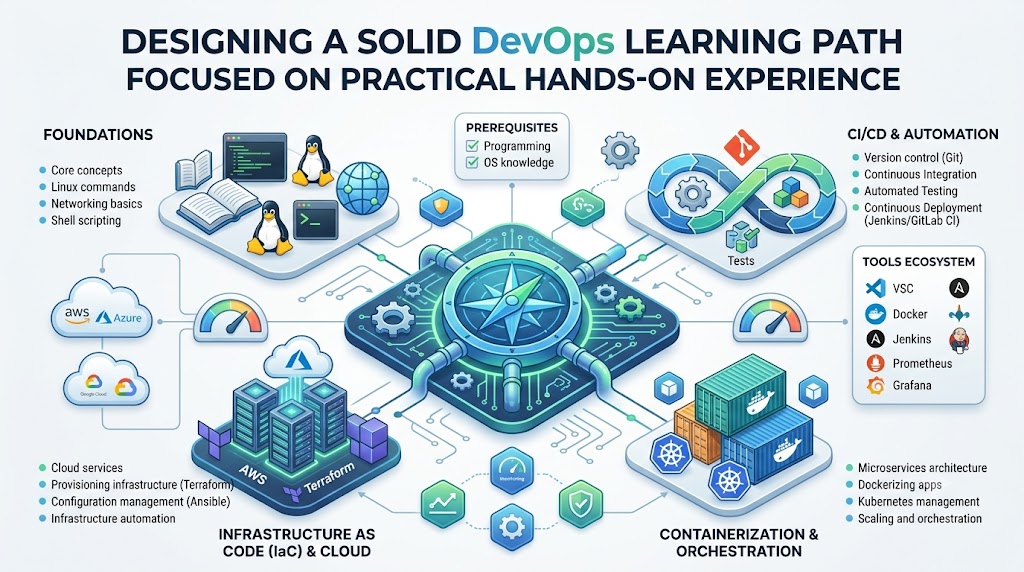
Begin your studies with elementary topics and advance toward complex systems. First, explore Linux because this operating system powers almost all internet servers. Next, use Git to save and record revisions inside your project folders. After Git, study computer networking to discover how machines share web data. Cloud systems come next so you can launch remote servers over the web. Then, study Docker to bundle programs inside lightweight software containers. Containers help code run without errors on any computer. Build automated CI/CD pipelines next to test and deliver your updates. Afterwards, master Kubernetes to control multiple containers across vast server networks. Write configuration scripts to set up infrastructure automatically using code files. Finally, add monitoring alerts to track system health and catch digital intrusions.
You can organize this educational journey into five practical stages that guide your everyday practice:
- Stage 1: Foundations
- Main Skills: Linux, Git, and basic networking.
- Simple Goal: Learn how servers operate, master terminal navigation, track code changes, and understand internet routes.
- Stage 2: Packaging & Cloud
- Main Skills: Docker and major cloud platforms.
- Simple Goal: Package applications into clean containers and launch virtual cloud machines on the web.
- Stage 3: Automation
- Main Skills: CI/CD pipelines and scripting languages.
- Simple Goal: Run automated tests and ship software updates quickly without manual work.
- Stage 4: Orchestration & IaC
- Main Skills: Kubernetes and Terraform.
- Simple Goal: Coordinate large container fleets and construct complete servers using readable instruction files.
- Stage 5: Reliability & Security
- Main Skills: Monitoring systems, log analysis, and defensive security.
- Simple Goal: Track uptime performance, inspect error messages, fix crashes, and protect data from hackers.
DevOps Engineer Roadmap
Practical project experience transforms standard theory into real engineering talent. Start by entering basic terminal commands on a local Linux computer every day. Commit your project text files and code changes to a remote Git repository. Write concise Bash or Python scripts that automatically tidy up temporary server folders. Pack a lightweight web page inside a clean Docker image. Push that container image onto an inexpensive cloud server online. Connect your Git branch to an automated deployment pipeline. Whenever you submit fresh code, the pipeline runs checks and deploys the updates. Set up Kubernetes to bring your web page back to life if it crashes. Create infrastructure scripts that construct new servers on demand. Install alert tools that ping your phone whenever website traffic stalls.
Consider this clear practical project as a guide. Build an online portal where classmates submit homework assignments. You write the underlying code and track revisions using your local Git tool. Next, you wrap the entire application within a portable Docker container. Your automation pipeline tests every new line and delivers it to a cloud host. Kubernetes automatically spawns new website copies when hundreds of students log in together. System monitoring tools record memory numbers and web response speeds continuously. An automated pager rings your device if the server memory runs out. This single project binds your fundamental abilities into one working creation.
DevOps Tools You Should Understand
Do not try to memorize hundreds of confusing product names right away. Focus your energy on tool families instead of individual brands. Code repositories hold your source files and document every change your teammates make. Container platforms package your app with all needed libraries so it runs everywhere. Pipeline engines evaluate, build, and publish your latest features automatically for customers. Container orchestrators organize and manage massive fleets of application containers day and night. Infrastructure as Code tools construct complex cloud hardware simply by parsing text blueprints. Health checkers supervise server activity and display live visual graphs of system memory. Log aggregators gather system messages into searchable files so you spot errors fast. Cloud networks provide storage drives, processors, and web addresses over the internet. Defensive security utilities scan container files and source code to block hostile intruders. GitOps managers synchronize live cloud infrastructure with your approved Git changes.
Here is an overview of the key tool areas, their core purposes, and popular examples to know:
- Source Control Tools
- Purpose: Preserve programming history and coordinate team contributions across shared files.
- Example Tools: Git, GitHub, and GitLab.
- Container Tools
- Purpose: Package application files and runtime libraries into uniform, lightweight units that execute anywhere.
- Example Tools: Docker and Podman.
- CI/CD Automation Tools
- Purpose: Verify code correctness with automated tests and ship new software builds directly to servers.
- Example Tools: Jenkins, GitHub Actions, and GitLab CI.
- Orchestration Tools
- Purpose: Balance network traffic and scale container clusters automatically across multiple physical hosts.
- Example Tools: Kubernetes and Docker Swarm.
- Infrastructure as Code Tools
- Purpose: Assemble virtual hardware, storage drives, and security networks using readable instruction files.
- Example Tools: Terraform, OpenTofu, and Ansible.
- Monitoring & Log Tools
- Purpose: Display system vitality graphs, collect operational event logs, and sound alerts during unexpected failures.
- Example Tools: Prometheus, Grafana, and the ELK Stack.
DevOps Tools Comparison Made Simple
Beginner students frequently wonder which single tool reigns supreme across the industry. The straightforward reality remains that different technology teams face completely different problems. Compare candidates by looking directly at their core jobs and features. Notice how much time your teammates need to learn each option. A few lightweight programs deliver value on your first afternoon of testing. Other complex frameworks demand months of intense study before providing clear results. Measure the total computing bills and licensing fees for each selection. Inspect existing security protections, community discussion boards, and system connections. System connections allow different software applications to exchange information without friction. Take inventory of your current team talents before adopting brand-new software. An extremely popular industry tool might bring excessive complexity to your simple workflow. Choose straightforward utilities that address your specific engineering hurdles effectively.
DevOps Certifications Roadmap
Professional credentials show employers that you understand modern industry best practices. Novice engineers should chase certificates only after constructing actual computer projects. Passing an exam never replaces practical hours spent building software systems. Select an assessment that aligns directly with your immediate learning targets. Introductory cloud credentials explain general technology terms and common architectural components. Practical command-line tests demand real troubleshooting skill inside timed virtual computers. Examine the test fees, duration limits, and validity periods before registering. Most corporate certifications run out after two or three years of validity. Review the public exam outline carefully and solve practice tests under timed conditions. Build mock networks and practice projects on your personal laptop. Exam certificates validate dedicated study habits, but concrete portfolio projects secure permanent job placements.
SRE Roadmap
Site Reliability Engineering centers on maintaining speedy, durable web applications around the clock. The learning path for this specialty branches directly off your baseline DevOps knowledge. SRE practitioners depend upon deep Linux, networking, and cloud system experience. Beyond those basics, you study telemetry metrics, error records, and incident alert systems. SRE specialists establish reliability targets known as Service Level Objectives. These targets establish the exact level of acceptable server downtime each calendar month. Next, you develop prompt incident response techniques to resolve sudden server outages. You program remediation scripts that fix known application issues without human intervention. You study capacity forecasting to purchase adequate cloud resources before traffic surges strike. Solid DevOps fundamentals equip you with the ideal groundwork for reliable operations roles.
Platform Engineering Roadmap
Platform Engineering represents a powerful discipline within modern software engineering companies. Platform engineers build handy internal systems that free developers from tricky infrastructure tasks. They manage complex cloud machinery so coders can focus purely on application features. This career roadmap encompasses cloud computing, Linux administration, containers, and Kubernetes. It further requires mastery over continuous delivery, automated infrastructure code, and security shields. Above all, it elevates the day-to-day developer experience across the company. Picture an organization where programmers wait days for simple test environments to open. A platform engineer solves this bottleneck by building an internal self-service portal. The programmer selects a few options on a web menu and clicks run. The automated platform generates the cloud server, database, and permissions in two minutes. Developers work happily without delays, and the company releases software much faster.
Real-Life Scenarios and Experiences
Real engineering teams overcome tough operational hurdles through practical automation methods:
- Scenario 1: The Broken Website Deploy
- Problem: An engineer transferred software updates manually into a live host and knocked the website offline.
- Learning Step: The engineering team discovered that manual file transfers invite catastrophic human mistakes.
- Tool Use: They constructed a GitHub Actions pipeline that validates and uploads every new release automatically.
- Result: The automated system trapped errors safely during testing, safeguarding users from nasty website crashes.
- Lesson: Automation banishes human slipups and creates a trustworthy deployment system.
- Scenario 2: The Crashing Server
- Problem: An online catalog crashed whenever heavy morning shoppers overwhelmed the host server.
- Learning Step: The company needed a responsive mechanism that creates additional web servers during sudden rushes.
- Tool Use: They migrated the web application onto Kubernetes pods with horizontal autoscaling triggers.
- Result: Kubernetes launched extra application instances during rush hours and pruned them during quiet periods.
- Lesson: Orchestration software accommodates huge traffic surges automatically without requiring late-night human oversight.
- Scenario 3: The Slow Development Team
- Problem: Newly hired software coders wasted weeks wrestling with computer settings before committing fresh code.
- Learning Step: The organization required a standard development environment that anyone could start instantly.
- Tool Use: Platform engineers assembled ready-to-run Docker images containing all necessary software libraries.
- Result: Freshly onboarded programmers began writing production code on their opening day with one script command.
- Lesson: Centralized internal platforms reclaim lost engineering time and accelerate overall software delivery.
Common Mistakes to Avoid When Choosing Delhi Events
People who attend or host gatherings across Delhi frequently stumble into frustrating planning errors:
- Picking Venues Far From Metro Stations: City traffic creates massive road gridlock across busy transit corridors. Choose event locations that sit within an easy walk of an operational Delhi Metro stop.
- Ignoring Extreme Summer Heat: Open-air lawns during hot summer months leave guests completely exhausted. Reserve indoor auditoriums with central cooling or arrange functions during crisp winter weeks.
- Failing to Check Parking Space: Popular banquet venues in Central and South Delhi run out of open parking bays fast. Reserve dedicated vehicle spots or hire professional drivers to park cars safely.
- Missing Municipal Clearances: Running public gatherings without police permissions invites surprise closures by municipal officers. File paperwork for fire safety clearances and civic permits weeks before the event.
- Forgetting Power Backups: Sudden electricity outages shut down presentation screens and sound systems mid-speech. Contract heavy industrial generators that supply instant power during local electrical cuts.
- Overlooking Food Safety Standards: Unregulated street food vendors risk spreading painful stomach infections among attendees. Contract licensed food preparation companies that enforce strict kitchen sanitation protocols.
- Booking Without Sound Permits: Operating outdoor loudspeakers past ten o'clock at night violates municipal noise limits. Keep musical performances inside insulated halls or switch off amplified speakers before statutory curfew hours.
- Skipping Water Refill Stations: Meeting participants suffer from dehydration quickly during long exhibition hours. Install clean water filtration dispensers throughout every exhibition hall and meeting area.
How DevOpsSchool Fits Into Your Learning Plan
Assembling an effective curriculum on your own consumes immense amounts of energy. DevOpsSchool offers organized study roadmaps that guide students past technical roadblocks smoothly. The platform provides ninety-day learning schedules covering a wide assortment of technology disciplines. Learners can study organized frameworks for DevOps, Site Reliability Engineering, and Platform Engineering. You can also dive into DevSecOps, GitOps, and CloudOps methodologies. Use their comprehensive technology directory whenever you want to compare different software tools. This directory breaks down choices across container orchestration, cloud automation, and runtime security. DevOpsSchool further supplies certification guides, an official credentials registry, and interactive browser labs. Learners access beginner-friendly tutorials, reference a broad technology glossary, and explore career placement resources. These coordinated tools strengthen your technical capabilities throughout your personal educational journey.
DevOps Jobs and Career Growth
Developing solid infrastructure skills unlocks an assortment of promising technology careers today. A DevOps Engineer automates software pipelines to help teams deliver reliable code changes rapidly. A Site Reliability Engineer monitors service availability, resolves sudden outages, and maintains high uptime. A Cloud Engineer constructs, secures, and oversees computer infrastructure inside online cloud environments. A Platform Engineer invents self-service developer frameworks that remove friction for corporate programming teams. A DevSecOps Engineer introduces automated security tests into delivery workflows to defeat online vulnerabilities. You prepare for these open roles by constructing complete sample applications from scratch. Practice resolving strange system errors whenever your local test scripts fail. Explain your architecture choices and troubleshooting methods clearly during interview discussions. Practical technical know-how wins hiring managers over much faster than meaningless resume buzzwords.
Frequently Asked Questions
1. Which fundamental skill deserves attention first when studying DevOps?
Begin your education by mastering Linux terminal basics. Most corporate cloud servers and containerized applications operate entirely on Linux environments. Practicing daily shell commands enables you to edit system files, modify user rights, and troubleshoot processes. This operational comfort makes subsequent topics like Docker packaging and cloud server management much simpler to navigate.
2. Must an aspiring DevOps engineer master software programming?
Basic scripting abilities remain mandatory for anyone seeking operational employment. You do not need to construct large commercial applications like a dedicated software developer. However, you must write functional automation scripts using languages like Python, Bash, or YAML syntax. Scripting lets you automate server chores and configure reliable deployment pipelines.
3. How many months does it take to learn DevOps from scratch?
Most committed learners require six to nine months of consistent weekly practice.组织 Dedicating two focused hours each day helps you build foundational Linux, networking, and Git skills in ninety days. Spend the following three months packaging containers and constructing continuous integration pipelines. Dedicate your final months to building sample projects and rehearsing technical interview topics.
4. Can someone secure an entry-level DevOps role without prior experience?
Job seekers without past tech titles can enter the industry by demonstrating practical skill portfolios. Assemble three complete automation projects on your own computer and push everything to GitHub. Document your architecture choices, setup commands, and problem-solving steps inside a clean project readme file. Tangible project proof persuades prospective employers much faster than empty claims.
5. What factors separate DevOps responsibilities from Site Reliability Engineering?
DevOps focuses on accelerating software updates by breaking down divisions between developers and system operators. SRE focuses directly on maintaining software health, stability, and speed once users access it. DevOps professionals construct deployment automation, while SRE specialists watch operational metrics and manage outage responses. Both specializations build upon an identical technical foundation.
6. Which major cloud platform should beginners choose first?
Start your cloud education with Amazon Web Services, Microsoft Azure, or Google Cloud. Each provider applies similar underlying rules for compute instances, network routes, and storage disks. Once you learn how one provider operates, transferring your knowledge to another platform takes minimal time. Check local job listings to see which cloud vendor dominates your area.
7. Do tech firms demand certifications before hiring DevOps engineers?
Companies value proven practical ability far more than paper credentials alone. Earning a respected certification certainly helps your resume stand out to busy corporate recruiters. However, collecting test certificates without building real software projects will not keep you employed. Combine your test preparation with hands-on labs and functional project portfolios.
8. What essential problem does Docker solve for development teams?
Docker encapsulates application source files and necessary system libraries into a single portable container. This container behaves identically whether running on a personal laptop, a testing machine, or a public cloud host. The software eliminates the frustrating dilemma where code works on a developer's computer but breaks on live production machines.
9. Why do modern technology enterprises embrace Kubernetes so widely?
Kubernetes oversees and orchestrates thousands of active application containers spread across physical servers. When an application container fails unexpectedly, Kubernetes detects the issue and launches a replacement immediately. It balances incoming web traffic and adjusts server capacity to handle peak holiday rushes. Companies pick Kubernetes because it keeps digital platforms running without constant human intervention.
10. What benefits come from implementing Infrastructure as Code?
Infrastructure as Code lets systems administrators construct computer networks using simple, human-readable text files. Traditionally, technicians spent hours clicking complex web consoles to build virtual machines. Writing your hardware setup into code files lets automation engines construct identical environments in minutes. It makes technical setups completely repeatable, testable, and trackable.
11. Does everyday DevOps engineering work require advanced mathematics?
Daily engineering assignments demand almost no advanced mathematics knowledge. Basic arithmetic helps you balance cloud costs, size storage partitions, and forecast network throughput requirements. You do not need calculus formulas or theoretical algebra theorems to excel. Success depends upon analytical thinking, step-by-step problem diagnosis, and structured automation logic.
12. How can self-taught students practice DevOps tools without spending money?
Everyday students can practice modern DevOps techniques on a standard personal computer without paid subscriptions. Linux distributions, Git, Docker, and many Kubernetes development tools cost nothing to download and run. Most major cloud platforms grant free promotional tiers for an entire year. You can build automation pipelines and explore infrastructure without paying a dime.
Conclusion
Embarking on a software engineering journey becomes simple when you follow an organized plan. Secure your foundational knowledge first by practicing Linux commands, Git tracking, and networking basics. Focus on one skill at a time so you maintain steady progress without burning out. Turn theoretical concepts into permanent muscle memory by constructing simple applications on your home computer. Stop chasing every new tool name that pops up across internet forums. Instead, ground your knowledge in timeless engineering ideas that endure through tech industry shifts. Treat certifications as helpful bonuses that validate your consistent study habits. Eventually, explore related paths like Site Reliability Engineering and Platform Engineering to broaden your career horizon. Solve real problems, practice your skills every week, and you will build a solid technical career step by step.