Clear Introduction To Observability Logging And Tracing In Modern Cloud Native Deployments
Introduction
Every phone app needs steady computers to stay alive without crashes. Many platforms fall apart when unexpected crowds join at the exact same minute. Site Reliability Engineering, called SRE, solves this exact challenge. The discipline blends traditional software authoring with daily computer system operations. Smart engineers type simple scripts to keep large cloud websites fast and sturdy. This fresh manual lays out reliable infrastructure ideas in straightforward steps. Readers discover essential tools, routine duties, and practical operational guides. SRESchool.in provides organized educational tracks to help newcomers master digital stability concepts smoothly.
What Is Site Reliability Engineering?
Site Reliability Engineering treats operational problems as pure software puzzles. The primary target involves keeping digital programs running cleanly for everyone. Reliability means a mobile app works without sudden, painful interruptions. Uptime indicates that a host machine remains awake and accessible. Fine performance ensures rapid screen loads whenever a person clicks buttons. Stability ensures systems remain firm during crowded midday traffic peaks. Operational groups apply automation, letting smart computers finish boring maintenance tasks alone. Engineers also activate monitoring, using digital sensors that inspect platform health continuously.
Why Does SRE Matter?
Normal people want instant results whenever they browse digital services. Bad downtime takes servers offline and locks customers out completely. Broken portals upset regular visitors and cause sharp public anger. Slow speeds persuade shoppers to close tabs and try different brands. Companies lose vital cash and public trust whenever digital networks collapse. SRE lets support teams catch tiny coding bugs before buyers face them. Systematic repairs stop the very same failure from striking a second time. True platform strength shields user loyalty and enterprise value equally.
What Does an SRE Engineer Do?
A dedicated SRE Engineer tracks live software operations across glowing terminal windows daily. They monitor clear dashboards so memory shortages never choke machines. Loud digital sirens notify staff whenever a remote server freezes. The specialist investigates the alert immediately and restores missing user data. Next, they write fresh automation code to prevent identical future failures. They balance cloud server supplies to welcome surging crowds safely. Reliable engineers collaborate with app developers to build durable system structures.
What Is SRE Training?
Pursuing SRE Training reveals the hidden gears running massive web platforms. Students practice core Linux commands, navigating cloud systems with simple terminal prompts. Monitoring ensures that distant server clusters remain online and functional. Deep observability lets engineers look inside complex software layers to reveal tricky faults. Teams measure distinct SLIs, checking real response times and delivery accuracy. SLO targets guide team decisions regarding system performance each quarter. Official SLAs state contractual promises delivered straight to paying business clients.
Core SRE Service Terms
Reliability teams track performance numbers to keep systems running smoothly for every user. These practical metrics set clear expectations and protect engineering teams from burnout:
- SLI (Service Level Indicator): Measures the actual speed and correctness of a digital service, with a typical target like 99.5 percent successful requests.
- SLO (Service Level Objective): Sets an internal reliability target for the engineering team, such as maintaining a 99.9 percent uptime goal.
- SLA (Service Level Agreement): Defines an official business promise made directly to paying clients, often guaranteeing at least 99.0 percent uptime.
- Error Budget: Represents the allowed room for minor, harmless mistakes, giving developers about 0.1 percent downtime space to test new features.
Why Consider SRE Certification?
A recognized SRE Certification proves your firm grasp of core reliability theories. Formal programs organize chaotic topics into clean, step-by-step milestones. The learning path gives novices confidence while navigating complex cloud systems. But paper credentials alone never turn beginners into seasoned pros. You must build practical computer experiments on home workstations. Merging structured testing with dirty keyboard practice produces brilliant technical gains. Home lab experiments teach how live internet infrastructure behaves during sudden shocks.
What Should an SRE Course Include?
A balanced SRE Course guides students across practical milestones:
- Beginner SRE concepts: Discover core reliability rules and simple system terms.
- Linux and system basics: Enter commands inside live terminal shells to manipulate files.
- Monitoring and alerts: Build bright digital dials that spot falling servers instantly.
- SLI and SLO concepts: Define smart thresholds for digital latency and availability.
- Incident management: Coordinate calm system recoveries during major cloud emergencies.
- Cloud and containers: Package software bundles neatly inside portable virtual units.
- Automation: Produce compact scripts that banish dull manual interventions.
- Infrastructure management: Construct cloud server farms using plain text files.
- Reliability projects: Launch functional sample applications and inject realistic failures.
- Production practice: Repair simulated platform disasters safely without impacting living users.
SRE Training in India
Tech firms across India develop expansive digital networks for global audiences. Fast-growing enterprises seek competent talent to run large server farms without hiccups. Ambitious teams request extensive Site Reliability Engineering Training to handle heavy consumer demands. Successful staff master cloud orchestration, continuous automation, and swift emergency troubleshooting. SRESchool.in offers practical educational pathways that sharpen these specific competencies. Motivated individuals acquire the knowledge needed to guard modern operational networks securely.
SRE Tools
System defenders rely on specialized tool categories to keep digital platforms fast and accessible. These modular software tools run computers, watch server health, and deliver warnings:
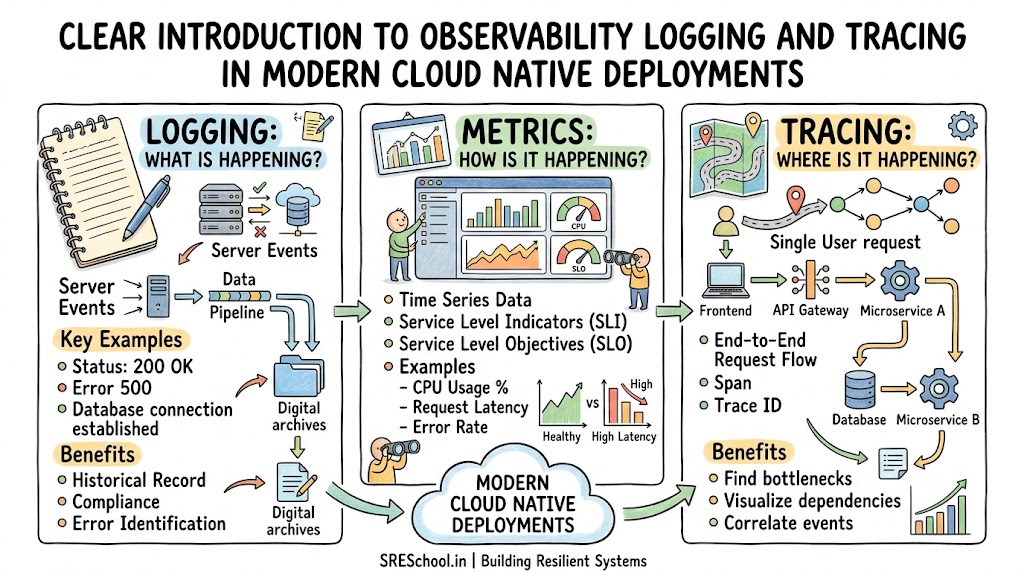
- Monitoring: Tracks overall computer health by inspecting vital metrics like memory and processor errors.
- Logging: Records digital system events continuously so engineers can pinpoint hidden software faults.
- Tracing: Tracks individual user requests step-by-step to reveal lingering network delays across web services.
- Alerting: Sends rapid warning messages to notify on-call engineers about serious platform incidents.
- Infrastructure: Controls cloud computer resources by letting teams assemble virtual cloud servers using Terraform.
- Containers: Packages applications into isolated bundles so teams can distribute and run microservices through Kubernetes.
SRE Best Practices
Adopting SRE Best Practices makes intricate digital environments robust and predictable. Technology teams establish explicit uptime targets so everyone shares common priorities. Engineers harvest valuable operating figures instead of hoarding pointless machine noise. They design sensible warning rules so on-call workers wake up only for emergencies. Suppressing false alarms protects rested engineers from overlooking dangerous breakdowns. Technicians automate tedious chores, saving valuable energy for creative architecture designs. Coders test every small program adjustment carefully before public launches.
Real-Life Scenarios
- Handling Flash Crowds: An e-commerce portal welcomes huge crowds during seasonal promotions. A smart autoscaling rule boots up additional cloud nodes, preventing painful checkout freezes.
- Catching Runaway Leaks: An imperfect feature patch swallows spare RAM at high speeds. Diagnostic alarms alert the deployment pipeline, which removes the faulty release automatically.
- Rerouting Network Breaks: A lightning strike disables a primary database connection at night. A standby duplicate accepts incoming traffic immediately, keeping customer checkouts smooth.
Common SRE Mistakes to Avoid
- Tolerating Flapping Alerts: Groups ignore chronic warning alarms until an entire platform collapses. Solution: Silence irrelevant notifications and repair valid warnings immediately.
- Relying on Manual Repairs: Workers restart broken services by hand every single afternoon. Solution: Write clean software scripts to handle cyclic reboots automatically.
- Punishing Human Errors: Managers penalize engineers whenever sudden coding bugs appear. Solution: Examine how brittle systems enabled the human slip safely.
- Demanding Zero Flaws: Leaders mandate unbroken 100 percent service uptime all year. Solution: Establish a realistic error budget to accommodate experiments.
- Forgetting Disaster Drills: Teams store system backups without ever testing file recovery procedures. Solution: Rebuild test databases from saved copies every month.
- Concealing Platform Accidents: Panicked developers conceal broken components to avoid awkward office scrutiny. Solution: Publish blameless incident reviews so peers gain collective knowledge.
- Dropping Massive Updates: Teams release gigantic software patches on Friday evenings. Solution: Push small, incremental feature sets during safe morning windows.
- Exhausting On-Call Staff: A single technician carries the noisy emergency pager indefinitely. Solution: Rotate night shifts evenly across all team members.
How SRESchool.in Can Support SRE Learning
Organized curricula make absorbing cloud reliability ideas enjoyable and straightforward. SRESchool.in provides thorough materials for candidates pursuing structured SRE Training in India. Learners inspect an accessible SRE Tutorial to clarify confusing system jargon. The curriculum unpacks popular SRE Tools while demonstrating effective operational disciplines. Individuals targeting a Site Reliability Engineering Certification develop sharp operational habits. Through progressive modules, aspiring specialists discover how to command real cloud systems effectively.
SRE Learning Roadmap
- Learn: Read foundational texts explaining servers, networking layers, and platform safety.
- Practice: Run command lines inside a private Linux terminal each afternoon.
- Build: Package a basic web server inside a portable container.
- Test: Bombard the container with artificial traffic spikes to observe bottlenecks.
- Improve: Construct self-healing automations to recover broken processes automatically.
Frequently Asked Questions
1. Can a beginner learn Site Reliability Engineering?
A curious newcomer can grasp reliability principles through steady study habits. Nobody needs decades of advanced programming experience to begin this journey. Start by observing how operating systems manage storage blocks and web queries. Then, write small automation routines to eliminate simple manual steps. Patient repetition transforms eager beginners into reliable infrastructure stewards.
2. Is coding needed to work in SRE?
Technicians write code to automate operational tasks on server systems. You avoid constructing massive consumer phone applications from the ground up. Instead, you author small scripts that inspect machines and configure cloud hardware. Languages like Python, Go, or Bash perform these duties very well. Simple scripts liberate humans from tedious operational work.
3. What is an error budget in simple words?
An error budget represents the acceptable amount of downtime for an app. No computer system can run uninterrupted through every single minute of life. Minor glitches happen because physical machines wear down and wires fail. The error budget shows when teams can test innovative updates safely. Exhausting the budget forces groups to pause updates.
4. How does SRE differ from DevOps?
DevOps describes a cultural movement connecting software developers with IT administrators. SRE supplies a concrete, hands-on framework to make that partnership work. While DevOps asks groups to collaborate, SRE provides mathematical rules and tracking tools. You can treat SRE as a practical implementation of broader DevOps goals. Both paths seek stable software delivery.
5. Why is 100 percent uptime unrealistic?
Chasing total perfection drains corporate funds and stalls product improvements completely. Guaranteeing flawless operations demands massive duplicate server hubs across many continents. Even then, severe storms, backhoe accidents, or hardware failures trigger brief interruptions. Normal buyers do not require absolute perfection to browse digital services happily. Accepting small hiccups enables steady product progress.
6. What does an on-call engineer do?
An on-call responder monitors pager signals to address acute system failures rapidly. Whenever a production process stops working, monitoring agents alert the designated specialist. The responder opens their laptop, investigates the failure, and restores digital services. Engineering groups rotate this responsibility so people rest properly. Smart organizations automate recurring emergency repairs.
7. What is a postmortem meeting?
Postmortem sessions bring colleagues together after significant digital accidents occur. The group identifies structural weaknesses rather than assigning personal blame to teammates. Workers document the timeline, the response steps, and the underlying root trigger. Next, participants create actionable tasks to prevent that identical fault from returning. This open dialogue strengthens system resilience.
8. What is Kubernetes used for?
Kubernetes automatically organizes and balances isolated application containers across server clusters. Containers bundle application code with necessary libraries so programs operate everywhere reliably. When website visitors surge, Kubernetes launches extra containers to distribute the load. The engine replaces broken containers immediately without human intervention. The tool keeps digital applications humming smoothly.
9. What is Terraform used for?
Terraform lets technical teams define virtual cloud hardware through plain code. Instead of clicking menus inside cloud consoles, you draft your requirements in files. The program processes those declarations and provisions corresponding servers, disks, and subnets. This automated technique ensures fast, repeatable setups without human configuration blunders. The utility makes cloud scaling simple.
10. Does earning a certificate guarantee a job?
A certificate confirms theoretical knowledge but cannot substitute for practical experience. Credentials show hiring managers that you understand technical vocabularies and platform designs. However, interviewers prefer to examine home projects built with your own hands. Practice assembling functional monitors and repairing broken virtual platforms. Tangible problem-solving skills secure great job offers.
11. What is observability in computer systems?
Observability lets technicians deduce system health by evaluating exterior data outputs. Basic monitoring sounds alarms whenever a server cluster drops offline completely. Observability illuminates the internal reasons behind that unexpected operational freeze. The technique connects machine metrics, network traces, and transaction logs to expose bugs. Deep visibility accelerates troubleshooting significantly.
12. How can I start learning today?
Launch a free Linux virtual machine on your home laptop today. Navigate internal folders and inspect active processes using basic text inputs. Next, browse an accessible SRE Tutorial to set up simple performance checks. Build tiny practice programs and discuss your learning with online student communities. Steady curiosity and regular keyboard practice produce remarkable skills.
Conclusion
Building resilient computer systems demands steady focus, clean code, and alert monitoring habits. Software teams depend on reliability engineers to keep important applications running smoothly every day. You do not have to master every complicated technical concept immediately. Begin by learning core Linux commands, building tiny scripts, and setting up basic monitors. Platforms like SRESchool.in offer structured learning paths that help engineers understand complex cloud systems step by step. With regular practice and genuine curiosity, you can build software environments that stay strong under pressure.